

Today’s admissions leaders are faced with a difficult challenge. Pressure to meet enrollment targets is increasing just as technological innovation is opening the doors to all sorts of non-traditional educational opportunities. For colleges and universities, a deeper look at your admissions process to see how unidentified accessibility barriers are blocking candidates from applying to your school could uncover a significant group of underserved applicants.
In the United States today, one in four adults have a disability and one in five live with a mental illness.
“Having accessibility-related communications makes your school seen by our often untapped community,” explained Alexa Soares, a current MBA student living with depression.
“Many students with disabilities and mental health problems hold back from applying to colleges because they don’t feel that they fit the description of what the school is looking for,” added Jimena Vergara, a current MBA student living with anxiety.
Without the proper admissions tools and strategies in place, schools are inadvertently creating barriers for these applicants and, as a result, are missing out on a large pool of talented applicants.
“There is a huge movement surrounding inclusion in higher education that’s happening right now and accessibility is a part of that,” added Laura Chavira Razo, a current MBA student who is hard of hearing. “Schools that don’t realize this and adjust their processes accordingly are going to be seen as outdated and antiquated. Innovative, forward-thinking schools will be the ones that attract top students.”
The Higher Ed Admissions Accessibility Report contains the latest research and insights from leading voices in the higher ed admissions and accessibility spaces, as well as first-hand experiences of students with accessibility needs as they navigated various admissions processes. These doctors, business leaders, engineers, and philanthropists lend insights into how schools can reach a wider range of talented applicants with just a few adjustments to their existing admissions processes.
Based on these discussions and findings, this report provides seven simple ways to reduce accessibility barriers in your admissions process - helping you attract a diverse pool of differently-abled applicants.
For the University of Detroit Mercy School of Dentistry, the advantages of virtual interviewing are not a new discovery. Long before the pandemic made remote interviews a necessity, Detroit Mercy Dental was using them to help make more informed admissions decisions.
A private institution in the Jesuit and Mercy tradition, Detroit Mercy Dental not only provides students with a top-notch education and ample clinic experience but cultivates in its students a life-long commitment to serving the community.
In the past, the school relied on cognitive variables to assess and admit students. After reviewing GPA and Dental Admissions Test (DAT) scores, successful applicants were invited to an in-person interview. But as these cohorts progressed through the program and landed on the clinic floor in their third and fourth years, Detroit Mercy Dental noticed that while students were academically very strong, several were missing the mark with their interpersonal skills.
Discover how to redesign your admissions process to address the era of grade inflation
“We knew we needed more data points beyond just the cognitive variables in order to make better admissions decisions,” shared Dr. Steven Chang, the Director of Admissions at Detroit Mercy Dental.
“Since 2016, Kira Talent has been helping us identify applicants who will succeed in both the classroom and the clinic.”
Trusting the experts
When Detroit Mercy Dental first decided to incorporate holistic review into their process five years ago, the admissions team briefly considered developing a tool in-house. But taking on the work – from design and building to maintenance, upgrades and user assistance – wasn’t feasible.
Instead, Detroit Mercy Dental turned to Kira Talent, where they were able to build a custom process that was backed by a full-service team with years of experience in the virtual admissions space.
“What we’ve learned over time is that you always want to go with the experts,” shared Dr. Chang. “Partnering with a company where this is their focus; this is their area of expertise, ensures you’re staying innovative.”
In the five years Detroit Mercy Dental has used Kira, the platform’s continually evolving features have added new depth to the school’s admissions process.
Discover how Kira’s newest features can enhance your admissions process
Through timed written and timed video responses, reviewers get an authentic picture of who applicants are off the page. And with the structured reviewing and on-demand availability of Kira’s Asynchronous Assessments, Detroit Mercy Dental has been able to streamline their process and reduce reviewer fatigue.
“It’s an easy and seamless process for our faculty and administration, as well as our applicants.”
“We really enjoy that we can assign the video responses to our reviewers and they can evaluate them at their leisure,” explained Dr. Chang. “All they have to do is click the rubric answers to generate applicant scores, and that has been so helpful in making things as straightforward as possible for our reviewers.”
Discover how Purdue University eliminated reviewer fatigue in the admissions process
A twofold approach for optimal success
Receiving over 2000 applications per cycle, the Detroit Mercy Dental admissions team invites every applicant who meets their minimum cognitive thresholds to complete a Kira assessment. From there, the team invites between 33% and 40% of applicants to attend an in-person interview*.
“It’s a twofold approach,” explains Dr. Chang. “An applicant's Kira results are an important part of assessing the whole candidate before the actual interview.”
The value of a Kira assessment for Detroit Mercy Dental is in the structured review, consistency of process for applicants and reviewers, and bias-mitigating features like the inter-rater reliability metrics. With these safeguards in place, reviewers are able to interact more freely with their applicants when it comes time for their live interviews.
“As much as we may try to maintain consistency across applicants during live interviews, it’s virtually impossible,” shared Dr. Chang. “By having Kira already provide a structured, consistent and unbiased assessment of the applicants, our live interviews are able to be more open-ended.”
Once applicants are invited to a Kira assessment and interview, they’re assigned to reviewers who follow them throughout the process. Once assigned, reviewers receive the applicants’ written applications with the cognitive scores masked.
“By keeping the GPA and DAT scores hidden until after the live interview, we reduce the potential for Halo bias,” explained Dr. Chang. “We want to create a level playing field and ensure that we’re really measuring something different through these interviews.”
Learn more about Halo bias and the nine other types of admissions bias
By assessing their written application, followed by their Kira assessment and their live interview, the reviewers can establish a comprehensive view of the applicant. When it comes time to make a final decision, there are multidimensional data points on which the applicant is assessed.
A selling point rather than an obstacle
When Detroit Mercy Dental first implemented Kira, there was some concern that applicants would be deterred by an added step in the process. However, over the school’s five years with Kira, they have not only seen an increase in applications but see less than 1% of applicants fail to complete their Kira assessment.
“It’s certainly not a deterrent,” Dr. Chang shared.
“Applicants jump at the chance to express who they are as a candidate.”
“And that’s true now more than ever,” he continued. “Over the past year of this pandemic, students have become accustomed to speaking into a camera. Any barrier that it may have presented before, in terms of discomfort or nervousness, doesn’t exist now.”
Discover how Des Moines University is reaching a new generation of applicants
Finding the diamonds in the rough
Pulling competencies from the AAMC Anatomy of an Applicant, Detroit Mercy Dental worked with the Client Success team at Kira to develop a pool of questions that focused on measuring applicants’ non-cognitive skills.
“We encourage reviewers to think about whether this is a student they would be excited to see in the classroom. Is this a student they’d be excited to see on the clinic floor?” shared Dr. Chang.
“With Kira, we’ve found that there are so many candidates who didn’t have the greatest cognitive score on their application, but when we look at their Kira scores and their interview scores, they’re exceeding expectations.”
“These are the candidates who the faculty are excited to teach," Dr. Chang continued. "They’re excited to mould them and help them become great dentists because they can see that they have great potential.”
“We don’t want to miss good candidates that may not show up as well on paper,” shared Dr. Chang. “A big part of succeeding in dentistry is patient interactions. Do they have empathy? Do they understand what it’s like to interact with people who are different than they are? These are things you can’t assess through grades and standardized tests.”
Download Kira’s comprehensive guide to holistic review
“Not all students have to have a 4.0 GPA. Not everyone can and that’s okay,” shared Dr. Chang. “As long as they meet the threshold that tells us they can successfully navigate the curriculum, what we really care about is their passion and their soft skills. These are far better indicators of how successful they will be as a healthcare provider, and ultimately, our goal is to graduate the best dentists.”
*a previous version of this post erroneously reported 85% are interviewed.
As the largest parish day school in the country, Holy Innocents’ Episcopal School enjoys a robust and active community of students, parents and faculty. Serving students from PK3 through twelfth grade, the school fosters a diverse and inclusive environment in which students can develop a genuine love of learning.
Placing a strong emphasis on an applicant’s respect for self and others, and sense of service to the global community, Holy Innocents’ has long incorporated holistic practices into their admissions process. Through one-on-one interviews with each applicant, the admissions team ensured that incoming students truly exemplified their school values.
When faced with creating a completely virtual admissions process, Holy Innocents’ needed a platform that could deliver the same depth of insight into their prospective students, while being completely remote.
“We needed to interview our applicants in a safe manner that was not going to be cumbersome to families,” explained Dr. Beth-Sarah Wright, the Director of Enrollment Management at Holy Innocents’ Episcopal School. “Thankfully, we had heard about Kira Talent.”
Discover where Holy Innocents is seeing their success:
- A seamless transition to virtual interviews
- Getting in-depth applicant insights by asking the right questions
- Bringing out the best in applicants and providing peace of mind to parents
- A solution perfectly designed for busy families
- Redefining fairness in the admissions process
- Staying ahead of the curve through innovation
Making a memorable admissions experience for applicants and their parents
“Prior to Kira, we conducted everything in-person,” shared Enrollment Data Manager Katie Patrick.
Using Kira to assess incoming students for grades four and up, the admissions team created completely custom assessments suited to each age group. By crafting questions, competencies and rubrics that were designed to effectively and fairly evaluate prospective students, Holy Innocents’ was able to recreate their traditional process in a virtual format.
Traditionally, for middle and upper school applicants – students in grades six through twelve – the in-person, one-on-one interviews centred around the school’s mission statement. Applicants were asked to share their understanding of its meaning and give examples as to how they exemplified those traits in their day-to-day lives.
With the fourth and fifth graders, the admissions team took a slightly different approach. Applicants had a one-on-one sitdown with a teacher where they worked through a variety of homework-style problems. In addition to academic aptitude, these exercises were meant to showcase an applicant’s problem-solving and interpersonal skills.
With a combination of timed-video and timed-written questions completed on the Kira platform, Holy Innocents’ was able to effortlessly transition the assessments for their lower, middle and upper school applicants online.
“With Kira, we ask applicants some get-to-know-you questions, followed by some open-ended questions which help us assess their soft skills,” Patrick shared. “Our fourth and fifth graders are then also given some skill-testing math questions and reading passages to assess comprehension and fluency. The math and reading comprehension exercises are the same for all applicants, but the get-to-know-you and competency-based ones are randomly selected from a bank of questions that we created based on the student’s grade level.”
An added benefit of the Kira assessments is the opportunity for Holy Innocents’ to showcase what makes their school culture unique. Questions are presented in videos pre-recorded by teachers, allowing the applicants to feel like they’re being welcomed into the school’s community.
“In a traditional interview, applicants would only meet one interviewer and that would be their touchpoint to the school,” explained Andrew Mack, the Assistant Director of Admissions at Holy Innocents’ Episcopal School. “With Kira, applicants are introduced to four or five of the teachers who make up our school community. It gives them a much better sense of what it would be like to be a student here.”
See how more schools are using videos to attract applicants
“With Kira, we’ve not only replicated our process, we’ve enhanced it,”
“The overall experience is more engaging for our applicants, and Kira has helped us ask more focused and nuanced questions that, while still geared towards our mission statement, enable us to dig a little bit deeper with the students,” Patrick added.
Asking the right questions to find the best students
Backed by a decade of experience, the Kira team helped Holy Innocents Episcopal School elevate their interviewing process, starting with the questions they asked applicants.
“Kira taught us about the types of questions to ask,” explained Dr. Wright. “The team showed us how to ask a question in a way that really encourages the applicant to think critically, and to respond in a way that reflects their true feelings and authentic experiences.”
“The questions that Kira helped us create were exactly what we’ve always wanted to ask, but were never able to figure out how to phrase properly,” added Patrick.
“We didn’t know exactly what to expect at the beginning, but working with Kira and building these assessments was just a joy and a pleasure,” Dr. Wright continued. “Kira gives us a pretty good picture of our students, who they are, what kind of student they are, what kind of citizen they are, and whether or not they would be a good fit for our school. And that helps us make informed and insightful admissions decisions.”
Creating a secure environment for kids to put their best foot forward
“Kira brought peace of mind to the online interviewing experience that we couldn’t have achieved with Zoom,”
“We were thrilled that it wasn’t going to be just another Zoom experience for students," continued Patrick. "Our applicants are as young as third graders, and as we don’t allow parents to participate in the assessment, the children were doing this completely independently.”
Kira’s straightforward, user-friendly design made it easy for their young applicants to complete the assessment on their own, while the all-in-one-platform structure ensured that they were safe while doing so.
“The parents really treated it as a professional experience for the children,” explained Dr. Wright. “We quite explicitly said no help from parents outside of technical set up, and parents really responded to that. Kira helped us set the right tone for the interview, so parents were at ease putting their third or fourth graders in a room with their headphones on to complete the assessment.”
Kira’s structured process, including timed responses, automated transitions and simple, clear instructions, helps keep the assessment on track without requiring assistance from an adult.
By preemptively flagging applicants who require attention, Kira has also helped instill confidence in the integrity of the processes.
“Kira alleviated significant stress from the admissions team.”
“Knowing that the platform was built specifically for admissions helped tremendously. There were no loopholes, no potential cracks in the process that we had to fill, no way to finagle the system,” explained Patrick. “Everything just automatically works as it’s supposed to.”
By creating an engaging and inclusive environment where applicants feel empowered, Kira assessments help give the admissions team a more authentic glimpse of each student and their unique personality.
“Extraverted students still thrived in their Kira assessment, just as they would have in person. But for the introverted students, Kira made a world of difference,” shared Mack. “With the in-person interviews, students were meeting their interviewer for the first time and were immediately having to answer all kinds of questions. With Kira, they’re in their own homes, with familiar people. They’re more comfortable, more confident, and it shows.”
Offering flexibility and ease to busy families
"With any new technology, there’s always some nervousness around an unfamiliar process,” shared Mack. “But once they got into the platform and understood how flexible and easy it is to use, the families and staff members were able to appreciate how useful the platform is."
The on-demand format of Kira’s Asynchronous Assessment means families don’t have to rearrange their busy weekend schedules to accommodate an on-campus interview. Applicants can complete their Kira assessment wherever and whenever they're ready to focus and put their best foot forward.
“The feedback we got from the applicants and their families was overwhelmingly positive.”
“People really appreciated the latitude with which they could complete their assessments,” Patrick explained. “In-person interviews can be extremely difficult for families to get to with their other responsibilities. Whether it’s extracurricular activities, family engagements, or jobs, it’s tough to find the time, especially if you’re applying to multiple schools or juggling the schedules of several children. Families have really appreciated the flexibility that Kira offers.”
Fostering a fair and consistent process
In addition to bringing a new level of ease to applicants, Kira helps Holy Innocents Episcopal School create an inherently fairer process.
In previous years, the admissions team had noticed how susceptible applicants were to the external circumstances surrounding their interview. Whether it was the decorations in the classroom, the noises from outside, or the interviewer’s mannerisms, seemingly inconsequential factors could tangibly change whether the child opened up, or shied away. By reducing those external influences, Kira has helped create consistency.
“In an in-person interview, applicants may be inadvertently swayed or guided by an adult in the room,” Dr. Wright explained. “Kira lets them respond on their own, without the influence of another person’s reactions or expressions coaxing or hindering their answers.”
Through a structured review process that includes a predetermined set of competencies and rubrics, Kira Talent also brings a level of consistency to the review process that helps the team mitigate bias.
“Our in-person interviews were one-on-one, so we were relying solely on the feedback from that one reviewer,” Dr. Wright continued. “With Kira, we can get multiple eyes on each student, and all the evaluations are completed individually, so that helps us create a fair and consistent process that reduces biases.”
“Kira’s inter-rater reliability metrics allow us to see how our reviewers scored the applicants; who tended to score more harshly and who was being too generous,” added Mack. “With the help of Kira, we’re able to gauge what a true and fair evaluation for each student is.”
Creating an innovative process for a new generation
With technology being a part of their lives earlier than ever before, students today are more attuned to the experience of representing themselves in a digital format. From video games to social media, navigating online experiences is practically second nature.
Far from being a barrier, this generation of students often feels more comfortable sharing who they are through video. Going forward, Holy Innocents’ sees Kira as a prime opportunity to keep a new generation of applicants engaged throughout the admissions process.
Discover how The York School is leveraging innovative tech to attract applicants
“We’re looking at how we would combine the Kira assessment with an on-campus visit,” shared Patrick. “As Kira is constantly evolving and offering more capabilities, it’s a way for us to keep our admissions process innovative.”
“Kira was such a good investment for our school.”
“We still don’t know exactly what next year will look like," continued Dr. Wright. "But even as restrictions are lifted we plan to keep Kira as part of our process.”
With only 31 veterinary schools across the United States, seats in the top programs are highly coveted. Out of the 1600 applicants who apply to the College of Veterinary Medicine at Purdue University Doctorate of Veterinary Medicine each year, 84 talented students are offered a spot.
“Given our small class size and the high demand for a seat, it can be very difficult to make selections,” shared Lori Stout, the Director of Admissions and Recruitment at Purdue University’s College of Veterinary Medicine. “That’s why we try to use as many diverse criteria as possible to help make that decision.”
In years past, Purdue used on-campus interviews to evaluate applicants’ soft skills, traits, and passion for veterinary medicine. Taking place over a span of two days, applicants were awarded a 25-30 minute interview with a program faculty member. When admissions processes were forced online, Purdue knew that forgoing interviews would be detrimental to the integrity of their selection process.
With the help of Kira Talent, the college replicated their interviews virtually, bringing flexibility, consistency, and equity into the process. Looking forward, Purdue wants to build on this momentum, leveraging Kira as a way to continue strengthening admissions.
Discover where Purdue is seeing their success:
- Creating an applicant-first admissions process
- Effortlessly transitioning online
- Building a consistent and equitable review process
- Eliminating reviewer fatigue
- Leveraging inter-rater reliability data
- Getting applicant buy-in
An easy choice for admissions teams
“We met with our admissions committee, and with the value of what Kira brings to our process, it absolutely doesn’t make sense to give it up,” shared Stout. “We want to build on what we’ve learned using Kira and tweak things to make this year’s interviewing process even better.”
Although Stout and her team are expecting campuses to be open next year, by keeping their interviews online they aim to reduce barriers for applicants in the admissions process.
Discover why Des Moines University is also continuing with virtual interviewing
“We typically invite 300-350 applicants to interview for our program,” explained Stout. “Before, those applicants would have had to travel to campus for their interview day. Now, these applicants are invited to complete a Kira assessment.”
“In veterinary medicine, one of the biggest issues that we’re facing, on a national level, is the education debt load,” Stout continued. “If we, as a field, are so concerned about student debt load, why are we asking them to incur all the costs associated with these interviews?”
For many schools, on-campus interviews have a twofold task of assessing applicants while also showing off program facilities and campus culture. But with most applicants applying to programs across the country, interviews can easily stack up. The associated costs, from flights or gas to hotels to time off work, can easily reach thousands of dollars. And given the competitiveness of the field, it’s not uncommon for applicants to pay for a visit to a school they won’t get an offer from.
Instead, Purdue is inviting applicants to visit campus after they’ve received an offer. The “offered student day” is extended to applicants who would like to visit the college and the campus before accepting their seat in the program.
“Our goal is to try to save them money upfront,” said Stout. “Once they’ve received an offer, they can choose to come to campus and see everything we have to offer.”
Eliminating the risk of technical difficulties and logistical nightmares
Before Kira Talent, the work of coordinating and scheduling interviews fell on Stout.
“We would send applicants their invitation via email with a link to a website that we had built and ran internally,” explained Stout. “From there, they were directed to choose between AM or PM, and then we’d assign them a slot.”
Between monitoring the website for glitches, assisting applicants through the process and accommodating requests for interview changes, Stout was not only conscious of the time it took, she was also worried about the likelihood of something slipping through the cracks.
“I had this huge spreadsheet that organized interview scheduling,” she explained. “As I assigned slots and made edits, I’d have to be so careful not to accidentally double up or delete someone."
"The margin for error was greater than I wanted to have.”
When it was clear that interviews couldn’t happen on-campus, Stout’s greatest fear was how she was going to bring the whole process online.
“I was thinking we were going to have to use Zoom, and that sounded like a logistical nightmare!” she shared. “I was not only apprehensive about the level of planning and coordination that would take, I was also worried about the risk of technical difficulties.”
“Not everyone involved in the admission process is technologically savvy,” Stout continued. “If Zoom were to cause issues, I wouldn’t be able to fix it and I wouldn’t have anyone to call for assistance. We would have been at the mercy of something we had no control over.”
From inviting applicants to assigning reviewers and tracking their progress, Kira unified the team’s tools and processes into a single online platform.
“With Kira, it’s as simple as clicking a few buttons,” shared Stout. “Having the manual work done for me makes everything so much easier.”
Redefining success with the help of expert advice
Prior to Kira, interviews at Purdue’s College of Veterinary Medicine centered around a list of required and optional questions. Using a 15-point scale equated to letter grades (a 15 equaling an A+), interviewers assigned applicants an overall score. “It was very difficult to enforce consistency within that system,” said Stout. “We couldn’t be sure everyone was asking the same thing or defining and scoring the same way.”
When introduced to Kira, Stout was excited by the equity it would bring to their admissions process.
“The Kira team helped transform the entire process. They helped us come up with more specific competencies to assess for, and helped us build structured rubrics to reduce the potential for bias,” Stout explained. “Looking back, that’s what we were lacking in our old process. When you don’t have a structured process in place, you can’t have everyone on the same page.”
Kira helped Purdue’s admissions team establish a focused set of competencies that could be defined on a rubric so that each applicant can be evaluated by multiple reviewers independently and consistently.
“During our onboarding, we did an exercise with our Client Success Manager (CSM) to identify our program’s values and which competencies were most important in successful students,” shared Stout. “Our CSM took those and came back to us with an ‘interviewing mission statement’. It was exactly what we wanted to accomplish but hadn’t been able to put into words."
"To know that the Kira team truly understood what would help us succeed – that was an exciting moment.”
The process helped Purdue create clear definitions, which in turn helped reviewers understand what to look for in an applicant’s response and how to evaluate it.
“Everything was clearly defined, not arbitrary, not subject to interpretation.”
Read more about Kira's client experience
Creating a process reviewers love being a part of
The simplicity of the Kira platform improved the process for Purdue’s reviewers as well. Because they were reviewing recorded responses, reviewers were able to evaluate their assigned applicants on their own schedule.
“I was worried I might have to push reviewers to get their scores in before the deadline, but that wasn’t an issue at all,” shared Stout. “Everyone completed their applicant reviews before the deadline, and I think the process being so convenient played a large part in that.”
In fact, Stout expects to see a rise in the number of volunteers for next year’s reviewing cycle.
“People who volunteered this year talked about how easy and convenient it was,” she explained. “They could sit down, at home, and complete a couple each night. So for next year, potential volunteers know that they don’t have to sit through a whole day of back-to-back interviews.”
Prior to using Kira, Purdue’s interview days ran from 8 am - 5 pm. By the end of the day, reviewers were, understandably, exhausted.
“I’ve had some interviewees tell me that their interviewer was disengaged,” shared Stout. “And it’s not because they aren’t interested, but by the afternoon of the second straight day, they’ve been listening to similar responses over and over. As hard as they try to stay engaged, reviewer fatigue is a real and inevitable obstacle.”
Discover what applicants thought of their experience with Kira Talent
This year, Purdue was able to offer reviewers a far less demanding schedule. By giving a timeframe in which they had to complete their evaluations, Kira allowed reviewers to work when it suited them best. “They could do things on their own, at their own pace, and when they knew they were in the right headspace and could give the applicant their full attention,” explained Stout.
Training reviewers based on data, not opinions
In addition to reviewer training during the onboarding process, Kira provides inter-rater reliability data to help admissions teams identify if and when a reviewer deviates from the average.
“The inter-rater reliability reports gave us concrete guidance on who we needed to reach out to and what we needed to work on.”
“Before Kira, I could only rely on feedback from applicants or my own personal estimations," shared Stout. "I didn’t have a full picture of how we were doing as reviewers, or if we were being fair to everyone.”
The admissions team now shares these reports with their reviewers, giving them active and concrete feedback on their work.
“It gives them an opportunity to re-assess how they evaluate an applicant, if they missed something, or if they saw something one way and could look at it differently. Before it was all arbitrary. If the applicant was good, they gave them a good score, but what score that was exactly really depended on the reviewer.”
Keeping applicants' best interest top of mind
As Purdue moves into its second year with Kira Talent, Stout and her team are making a point to share with applicants why the college is continuing with Kira Talent over in-person interviews, and how that benefits them.
“Firstly, we’re trying to save them money,” said Stout. “The cost of veterinary school is high enough. We don’t need to add to that by having them travel to all these interviews.”
“Secondly, this process helps us form an unbiased view, and that ultimately benefits the applicant. Their success isn’t determined by getting an interviewer with whom they connect because they’re from the same hometown or they have a dog with the same name. With Kira, we have a holistic view of every applicant, which means everyone is assessed on an equal playing field.”
For medical schools, Multiple Mini Interviews (MMIs) are a staple of the admissions season. A reliable method of assessing soft skills such as communication and critical thinking, MMIs provide insight into how an applicant would interact with patients and colleagues as a healthcare professional. For the Psychiatry Residency program at Queen’s University’s School of Medicine, this assessment of soft skills is integral to the admissions process.
With approximately 30 residents spread across the 5-year residency program, Queen’s offers students a balance of hands-on in-hospital rotations and educational research opportunities.
“We pride ourselves on producing really well-rounded psychiatrists,” shared Dr. Eric Prost MD, FRCPC, an Assistant Professor at Queen’s School of Medicine. “Our students have both research and clinical experience. They’re just as comfortable tackling scholarly projects and they are attending to any patient who walks in the door.”
So when Queen’s shifted their admissions process online, they needed a platform that could deliver the effective and engaging experience they wanted for their applicants, as well as the support and guidance they needed for their admissions team. They found their solution with Kira's Live Interviewing.
Recognizing the value of a virtual MMI
“Even before the pandemic there was a push within the School of Medicine to transition to virtual,” explained Dr. Prost. “The travel cost related to in-person interviews, both in terms of the effect on the environment as well as the financial cost to applicants, was something we were keen to address in our process.”
Excited as they were by the prospect of providing an accessible and environmentally conscious interviewing experience, the admissions team disliked the impersonal, and often problematic, nature of many off-the-shelf solutions.
“We needed a platform that would perform flawlessly and a virtual interviewing experience that would help us attract and enroll high-quality candidates. With Kira, both of those things happened.”
“If we were going to do it virtually there were two key factors that needed to be addressed,” explained Dr. Prost.
The first was the support behind the platform. “We didn’t want to be dealing with a bunch of IT problems,” shared Dr. Prost. “It’s not only extraordinarily frustrating for both the admissions team and our applicants, but it’s unprofessional and it tarnishes an applicant’s impression of our school.”
The second was the opportunity to market the program. “Part of the appeal of our program is the warmth and camaraderie of our residence group,” Dr. Prost continued. “Candidates often comment on how close-knit and friendly our residents’ group is. So we needed to be able to convey that virtually. Kira Talent met and exceeded those needs.”
Enhancing admissions from application to interview
With full confidence conducting their MMIs in Kira, Queen’s saw an opportunity to gain deeper insights into their applicants’ soft skills and traits earlier in the admissions process. In conjunction with their traditional written application components, Queen’s had applicants complete an Asynchronous Assessment in Kira. To help reduce bias in the evaluation process, each reviewer was assigned to review applicant responses for specific competencies. This horizontal review process, helps reviewers become experts in the competency they're assigned to, thereby improving the accuracy and reliability of their scoring.
“We want to be as objective as possible throughout each stage of the process,” explained Dr. Susan Ilkov-Moor MD, FRCPC, an Assistant Professor at Queen’s School of Medicine. “Adding the Asynchronous Assessment allowed us to hear from each applicant before making any decisions. By combining information from both the written application and the Kira assessment we ensured that we were making well-informed decisions based on a holistic view of all our applicants.”
Following their Asynchronous Assessment, successful applicants were invited to an MMI in Kira Talent. With Live Interviewing, Kira took Queen’s traditional MMI process and replicated it online. Through custom in-platform competency-based rubrics and seamless scheduling, the streamlined process enabled Queen’s to interview more applicants per day.
“Live Interviewing mirrored our traditional MMI and it did a great job of recreating the process,” shared Dr. Ilkov-Moor. “The whole process went extremely smoothly.”
The advantage of expert advice
By incorporating pre-recorded videos into the Kira platform, the program was able to showcase not only shots of campus but the personality and spirit of the faculty and residents’ group.
“We got feedback from an incoming student that they loved the opening video we had with Dr. Prost introducing the program” shared Dr. Ahila Vithiananthan BHSc. Hons., MD, a current psychiatry resident at Queen’s School of Medicine. “They also specifically commented on the quality of questions that Queen’s asked in the Asynchronous Assessment and the MMI, compared to some other programs. That’s largely due to Kira’s role in the creation of our interviews.”
Read more applicant feedback in the 2020 Applicant Experience Report
Guided by a decade of experience in the higher ed admissions space, Kira brings that expertise into the onboarding process. Kira helped the Queen’s Psychiatry Residency Program overhaul the rubrics and questions used in both the Asynchronous Assessment and MMI.
“Kira helped us create stronger questions and rubrics.”
“They were okay before but the competency workshop with Kira helped us create better ones,” shared Dr. Prost.
A golden standard for support
With Kira Talent already powering virtual assessments for the Queen’s undergraduate medical program, the Psychiatry Residency Program knew that Kira’s award-winning client experience would be an added support for their admissions team.
Discover what admissions teams have to say about their experience with Kira Talent
“It was a significant benefit for us to have the help of the Kira team,” shared Dr. Vithiananthan. “Kira was amazing throughout the onboarding process, always there to answer any questions, and was available during all the Live Interviews, on the weekend, supporting both the admissions team and reviewers, as well as the applicants.”
“The reason that we chose Kira was because we knew it wasn’t going to be us doing it on our own,” shared Dr. Prost. “Kira gave us an excellent online experience with no bugs and no IT issues. We could count on 24/7 support and a team to keep us organized and on track. And that was not only during the onboarding but throughout the assessment period and day-of for the MMI. I could not be happier, I have absolutely no complaints.”
Founded in 1898, Des Moines University has a strong history of innovation in the field of medicine and health sciences education. Comprised of three colleges that collectively offer nine graduate degrees, from Doctorates to Master’s of Science, DMU’s educational and research programs share a mission of improving lives in our global community by educating diverse groups of highly competent and compassionate health professionals.
With a new state-of-the-art campus underway, DMU will pioneer the use of technology — including artificial intelligence and virtual reality — in education, training, and clinical services. As DMU designs the medical and health sciences university of the future, Kira Talent is helping them deliver an admissions process to match.
A quick and seamless transition
DMU first engaged Kira in 2018, looking to add Asynchronous Assessments to the admissions process for their Doctorate of Physical Therapy program. When the pandemic put traditional admissions processes on hold, DMU was in an enviable position as they were able to quickly and seamlessly bring their other programs onboard.
“The coaching from the Kira team enabled us to act quickly and create a process that was both engaging and scalable,” shared Molly Moeller, Director of Admissions and Recruitment at DMU. “We’re always trying to be efficient and innovative in what we do while also being mindful of our applicants. So when the pandemic hit and we started understanding what the magnitude could be, our priority became securing a stable process for our applicants.”
Leveraging new tools to enhance traditional processes
The efficiency and ease of both the transition and the new process have lifted a weight off of both DMU’s admissions team and applicants.
“It’s not only that the technology is so intuitive, it’s also the Kira team,” explained Moeller.
“Kira did a lot of the heavy lifting to bring the process online so seamlessly. As we’ve moved through the cycle, the customer service, from assisting our admissions team or supporting our applicants, has been exceptional.”
Discover how Kira can support your admissions team
DMU uses Kira’s Asynchronous Assessment in conjunction with an optional live group interview, where applicants can engage in informal discussions with faculty members from the program. The group interview, Moeller explained, helps DMU get a glimpse of applicants in an interactive setting while the Kira assessment provides a consistent process for all applicants and mitigates the potential for bias.
“Our committee looks at how applicants performed in each event,” she continued. “It’s a twofold approach, one doesn’t outweigh the other.”
With Kira incorporated into the admissions process, DMU has not only reduced travel costs for applicants but has delivered an engaging and professional applicant experience.
“Students have been very appreciative of that stability,” shared Moeller. “They appreciate the thought that went into the experience we were able to deliver over this past year.”
The reviewer experience got high marks as well, with faculty and staff highlighting how applicants seemed as authentic in their Kira assessment responses as they would have been in an in-person interview.
“The feedback has been very positive,” Moeller continued. “I think they didn’t expect it to be as genuine as it turned out to be. They still get a really good sense of the applicants.”
Powering the future of admissions
In the long term, Moeller and her team at DMU see significant value in continuing with a virtual admissions process.
“Right now we have public health concerns that we want to help mitigate, and we don’t know how long that will go on,” explained Moeller. “But beyond that, schools need to look for ways to meet the applicants where they are.”
“In-person interviews, as we have always done them, are not sustainable,” Moeller continued. “It’s a big expense for candidates.
"Kira fits with who DMU is and who we continue to become. It’s one of those pieces that we see as being part of our future, long-term.”
The Northeastern University Bouvé College of Health Sciences School of Pharmacy and Pharmaceutical Sciences PharmD direct-entry pathway (PharmD DE pathway) offers students a seamless transition from their undergraduate degree into the first professional year of the PharmD program.
Known for its co-op program, the PharmD DE pathway balances campus-based and experiential learning, giving its students three times as much experience in rotations as any other program in the United States. For Christina Folsom, Admissions Coordinator for the PharmD DE pathway, it’s this open-armed approach that makes the program stand out to applicants.
“Our faculty are so committed to our students,” she explained. “They want to see students come to Northeastern Pharmacy and succeed in the program. It is very genuine, it’s not a sales pitch.”
Having received consistently stellar reviews from applicants on their in-person interview days, the bar was set high for the admissions team as they transitioned their interviews online in the spring of 2020. With the help of Kira Talent, they've ensured their interview experience continues to be nothing short of exceptional.
Why soft skills are a hard requirement
Affiliated with pharmacies, clinics, and hospitals throughout the United States, the PharmD DE pathway offers its students ample hands-on experience in their field prior to graduation. From interacting with patients to collaborating with healthcare professionals, communication skills play an important role in student success.
“We want to continue building relationships with these world-class healthcare-providing facilities,” Folsom explained.
“If we were to send them students who continually miss the mark on that communication piece, that’s not going to happen.”
Together with traditional academic metrics, the program evaluates applicants on factors such as problem-solving and critical thinking. When it comes to admitting students into the direct entry pathway, they’re looking for applicants who can hit the ground running.
In previous years, the admissions team was able to identify these soft skills through in-person interviews. When that was no longer possible, Folsom and her team tried putting together a home-grown system that could replicate their traditional process online.
“We tried to create our own virtual system,” she explained. “But we’re a school of pharmacy, not a software company."
"We weren’t achieving the outcomes that we wanted to see.”
That’s when they turned to Kira Talent.
Leveraging a tailor-made tool
Over a quick 4-week onboarding, Folsom and her team worked with Kira to build an assessment that was efficient and thorough without feeling impersonal.
“The ability to reach out to the Kira team with a question or a change and have that promptly answered or taken care of has been hugely beneficial,” Folsom shared. “I want to learn as much as I can about the software. But I know that for my colleagues who don’t have as much time to commit to it, the Kira team is there to help them and keep the process flowing. It makes my life a lot easier.”
Through welcome videos and recorded questions, the PharmD DE pathway was able to showcase the dedication of their staff and the welcoming atmosphere on campus.
“Using Kira helps give off the vibe of who we are and what we’re looking to accomplish as an institution,” said Folsom.
“I don’t think you would get as much with a less customizable platform.”
Discover how Kira can support your admissions team
The program’s process with Kira is a three-pronged approach. Applicants submit their application, they complete a Kira assessment, and then they do a live interview. During their interview, applicants are asked application-based questions and follow-up questions to responses they gave in their Kira assessment.
“In this way, we let them know that we’re interested in what they’ve said and show that we’re invested in each student,” explained Folsom.
Engaging more applicants - fairly
“We used to only do in-person interviews, and they were required,” shared Folsom. “So before switching to Kira, we didn’t admit many international students to the direct entry pathway.”
Now, the program is able to enroll students from around the world, while still ensuring that they have the proper communication and interpersonal skills needed to succeed in their placements. And while a video call might seem like an easy solution, Folsom had concerns about the fairness of relying on that evaluation.
“I had one interview day where I had applicants from South Korea, Canada, Morocco, the US, and the Netherlands all at the same time,” she explained. “For some of them, it was happening at 5 am. With Kira’s Asynchronous Assessment, we get to see them when they're in a comfortable environment, at a time that they’ve chosen, and make sure we’re not putting them at any disadvantage.”
From tracking page refreshes to checking how many practice questions an applicant completes, the admissions team has used Kira’s reporting features to gain further insights into applicant behaviour.
“We’re very data-driven, so it’s great to be able to pull reports on both applicant and reviewer activity,” shared Folsom. “We can see an overview of the scores and see how each member of the faculty scores. It helps us ensure we’re maintaining an equitable system and that we’re training our reviewers to the fullest extent.”
The perfect enhancement to a traditional process
For Folsom and the PharmD DE pathway, Kira has been a seamless addition that has brought immense value to their admissions process.
“I think it complements our process in PharmCAS super well,” shared Folsom. “PharmCAS is so user-friendly. It has all the functionality I need as an administrator, while still being simple enough to be used by faculty and reviewers who may never have used a platform like this before. With Kira, I have the same confidence.”
Learn more about integrating Kira with Liaison’s CAS
And it’s not only the faculty and administration who are enjoying the benefits of a Kira assessment. With the majority of the program’s applicants applying directly from undergrad, the admissions team is conscious of the need to appeal to a new, tech-savvy generation.
“Whenever I look at changing something operationally within our admissions process, I want to make sure that I’m getting a beat on how our applicants look at things,” shares Folsom. “We’re coming from a different generation, a different background, a different educational experience, and possibly a different perspective. How we look at things doesn’t necessarily represent how our applicants see things.”
After conferring with work-study students, Folsom and her team felt that Kira gave the program the opportunity to connect with applicants where they were — online.
Looking to the future, the PharmD DE pathway is sure that Kira belongs as part of their process. “Kira is a great way to be able to assess applicants in advance of an in-person interview more efficiently because it’s completely virtual” shared Folsom. “We want to keep using it as a tool in the admissions process even once we’re back to having that final interview piece be in-person.”
Discover how other pharmacy programs are enhancing their admissions with Kira Talent
With each interview cycle comes fresh hassles and headaches. From scheduling faculty, to managing multiple interview links, to ensuring applicants show up on the right day at the right time, the excitement of the interviews can often be clouded by the chaos of preparation.
And while technology can help provide a smoother, more seamless experience for admissions teams and applicants alike, choosing the wrong tools will only make your admissions process feel like an obstacle course.
We know the pain of trying to use a tool that wasn’t built for the way you work. That’s why we've designed a solution that’s tailored-made for admissions teams. From one-on-one and panel interviews to Multiple Mini Interviews (MMIs), Live Interviewing in Kira Talent is the easiest way for your team to bring in-person interviews online. By unifying your tools and processes into a single online platform, Kira helps your team focus on what matters most: engaging with the next generation of talented students.
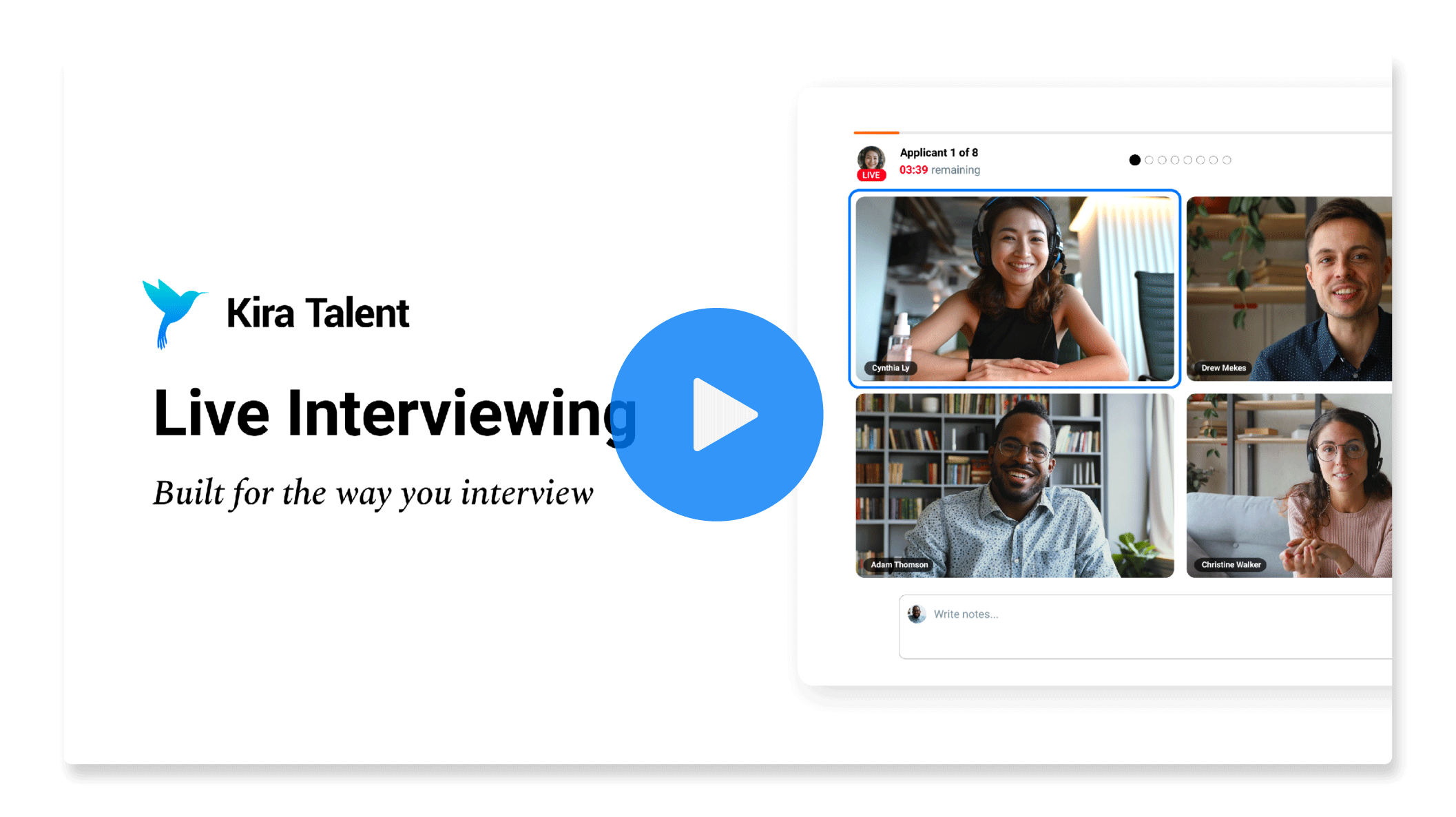
In our inaugural Live Interviewing Experience Report, you’ll see what applicants and reviewers had to say about their experience with Kira’s newest innovation, and what they think about the future of admissions interviewing.
How Kira is elevating the virtual interviewing experience
Built for the way you interview, each aspect of your traditional admissions process, from scheduling to reviewing, has been replicated and enhanced with Live Interviewing. The result is an online interviewing platform that provides a level of ease, efficiency, and professionalism to your process that other video conferencing tools simply can’t.
By making your interviewing process more accessible to a diverse range of applicants and more relevant to a new generation of students, Live Interviewing helps you better engage and assess your best-fit applicants.
Last year, Kira was approached by several schools that were frustrated by the limitations of the video conferencing platforms that were available. Just as ideation on Live Interviewing began, the pandemic hit and suddenly those schools needed a solution yesterday.
 The Kira team worked tirelessly to deliver a seamless experience, incorporating constant feedback from several Canadian medical schools to ensure that Live Interviewing would meet all of their admissions needs.
Throughout early 2021, Kira’s Live Interviewing supported hundreds of prospective medical students as they completed their MMIs. And as the Kira team continued to refine the platform, applicants and reviewers reported consistently better experiences.
With the majority of participants either preferring or being open to continuing with Kira’s Live Interviewing over returning to in-person interviews in the future, we can't wait to continue solving the biggest problems for higher ed admissions teams.
The applicant experience
By the numbers
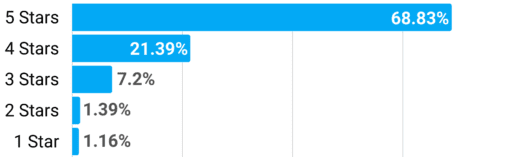
Applicants’ ratings of their Kira Live Interviewing experience on a scale of one to five with five being the highest
90.2% of applicants rated their Kira Live Interviewing experience either “Great” (4/5) or “Exceptional” (5/5)
Live Interviewing is proving its value right out of the gate! With tons of upgrades and new features on their way, we're ready to continue helping admissions teams get the most out of their process.
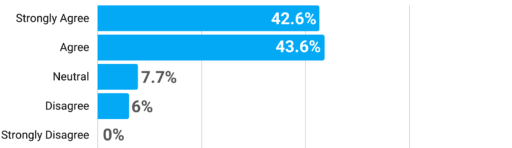
Applicants' response to the statement “The online delivery of the MMI through the Kira Talent platform allowed me to adequately communicate to the assessor."
86.2% of applicants “agreed” or “strongly agreed” that the online MMI with Kira Talent enabled them to successfully engage with reviewers.
58% of applicants preferred or were open to continuing with Kira’s Live Interviewing over returning to in-person interviews in the future.
While some schools felt forced into remote-friendly methods, more than half of this year's applicants fully embraced the shift to virtual interviewing. With a response like that, traditional methods of interviewing, with their inherently higher costs and accessibility barriers, may be a stumbling block for future recruitment.
By the comments
Applicants noticed and loved the continuous improvements to the platform
 “This is the third time I have used Kira Talent for medical school interviews or MMIs, and my experiences keep getting better. Thanks Kira!”
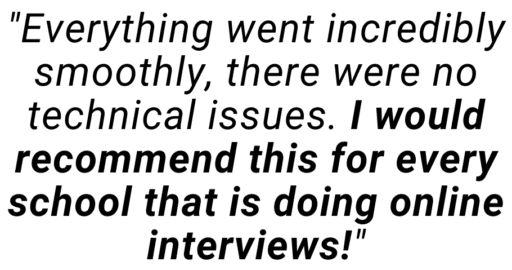
“Everything went incredibly smoothly, there were no technical issues. I would recommend this for every school that is doing online interviews!”
After delivering Live Interviewing in record time, we continued to enhance and strengthen the platform throughout the spring, adding features such as double-length stations and an admin dashboard! We’re proud to see the results of our hard work reflected in great feedback from applicants!
Some applicants had suggestions for future upgrades
 Overall the experience was good, I would say that it would be nice if we could move the videos to the top of the screen or move them around on our screen to facilitate eye contact.
“One thing I would like more would be if the videos of the participants were slightly larger. I like having the text of the question prompt on the side, but wonder if there might be a way to enlarge the videos of the participants on the screen.”
We're hearing you and we're taking notes! As we continue to enhance the platform we'll be adding new features to drive an even better Live Interviewing experience.
Applicants felt that Live Interviewing delivered an engaging experience
“Not having to juggle a bunch of WebEx or Zoom links during the interview certainly made things less stressful, and allowed me to focus solely on my responses to question prompts. Also, having the prompt remain on-screen is a GODSEND!”
“Kira Talent took the technology stress out of an already stressful day. It was so great not having to do anything with my laptop during the interview.”
At Kira, our number one goal is to deliver a platform that enables every applicant to put their best foot forward. Needless to say, this kind of feedback shows us that we’re on the right track.

The reviewer experience
By the numbers
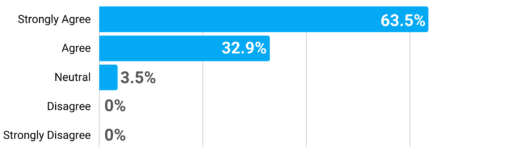
Reviewers’ response to the statement “The online delivery through the Kira Talent platform allowed me to adequately communicate with the applicant.”
96.4% of reviewers “agreed” or “strongly agreed” that a virtual MMI with Kira enabled them to successfully engage with applicants.
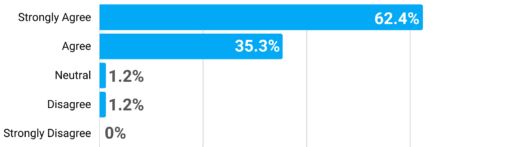
Reviewers’ response to the statement “The information provided by Kira Talent including an opportunity to pre-test my equipment and trial the interview platform was helpful in my preparation to be an assessor.”
97.7% of reviewers “agreed” or “strongly agreed” that the prep and tech support provided by Kira set them up for success as a reviewer.
With Kira, you’ll never have to worry about you, your reviewers, or your applicants being thrown in the deep end. Our award-winning Client Success team is on-hand every step of the way, from onboarding and reviewer training to real-time applicant support.
71.7% of reviewers preferred or were open to continuing with Kira’s Live Interviewing over returning to in-person interviews in the future.
Citing the platform’s flexibility, professionalism, and dedicated support, the vast majority of reviewers either preferred or were open to continuing with Kira’s Live Interviewing over in-person interviews in the future!
By the comments
Reviewers felt that Kira’s Live Interviewing provided an effective and fair experience
“The Kira Talent Platform worked very well for the MMI interview process this year. It was much better than WebEx the previous year - too many glitches and problems with timing/connection. Things went much smoother this year.”
“I thought the Kira platform was fantastic! Having been involved with the previous approach, I feel this approach has better validity.”
“I feel the process was both fair and equitable. The students had ample opportunity to communicate their response.”
One reviewer was so impressed, they wanted to be able to flag the superstars
“There is the occasional student who is just a cut above the rest and you say "Wow", however, with individual markings there is no way to identify such an individual. It would be nice if we could flag those students just as we flag our concerns or conflict of interest.”
We’re thrilled to hear that applicants are shining in their Live Interviews and we’ll explore this for future iterations of Live Interviewing!
Overall, reviewers loved the intuitive interviewing experience with Kira
“The interview format is excellent and far preferred to the in-person interviews.”
“I completely love how the whole process was planned. Very clear instructions from the team. The Kira Talent platform was user-friendly too. My pleasure to be a part of this.“
“The Kira platform is great and the interviews are all extremely well organized.”
Learn more about Live Interviewing in Kira Talent and contact the Kira Partnerships team to transform your next cycle of interviews.
Read more about the Kira experience
2020 Applicant Experience Report
The University of Nebraska Medical Center (UNMC) College of Allied Health Professions (CAHP) sought out Kira Talent for help with a unique need. Representing 12 programs, more than 15 health professions, and over 30 different academic tracks, the CAHP was looking for a way to establish a consistent admissions process across all programs, while still enabling each team to assess applicants in a way that works best for them.
“We took the challenge to the Kira team, thinking it may be too complex,” shared Kevin Howard, Enrollment Management & Student Affairs at UNMC. “However, our ideas were always met with enthusiasm!”
Together, the College and Kira built a cohesive offering that brought together a variety of options customized to each of the program’s unique focuses, while maintaining consistency across disciplines.
The flexibility to assess your way
“We created this “Kira menu” that programs could choose from,” described Maggie Winnicki, Director of Enrollment Management & Student Affairs at UNMC. “Each program would take it, discuss it, make their selections, and then come back to us to help build their unique assessment.“
The first step was for the programs to decide how they wanted to leverage Kira in their admissions cycle. Did they want to interview exclusively with Kira, or did they want to use it to complement their live interviews? Did they want to use the Kira assessment as the first step in the interview process or as the final round interview?
From there, each program chose which competencies they wanted to assess and what style of questions they wanted to use. Pulling from a bank of questions created by the CAHP Admissions Committee, programs were able to replicate and replace their traditional MMIs or add new depth to their process. There were behavioural questions, open-ended questions, and scenario-based problems. Questions could be fixed, giving each applicant the exact same experience, or they could be randomized, giving each applicant a unique combination of similar questions. Each question was evaluated using a standardized rubric, ensuring that the questions were being evaluated consistently across disciplines.
And if a program wanted something that wasn’t in the question bank? They also had the option of choosing their own questions and building a custom rubric.
Finally, each program chose how they wanted to score applicants. With Kira’s Flexible Review, they had the option of reviewing horizontally, focused on one competency across applicants, or vertically, focused on all competencies across one applicant.
With so many different variations to keep track of, the team was almost expecting some kind of mishap. But across all of the school’s programs and each unique assessment, CAHP saw success.
“We’ve had buy-in from all of our programs,” shared Winnicki. “They can still make decisions about how they’re running their admissions, what attributes they’re looking for in applicants, and what questions they want to ask. But Kira has allowed us to have that variation while maintaining structure and consistency across the programs.”
Creating a warm connection
“When we first spoke to our programs about Kira, some of them just wanted to stick with their current set-up in Zoom’,” recalled Winnicki. “But once they saw Kira in action and saw how it could enhance their process, they were sold on it.”
Kira’s asynchronous assessments provide UNMC with the opportunity to evaluate applicants through unscripted, unrehearsed video and written responses. And because Kira assessments are available on-demand, UNMC’s reviewers are able to review their assigned applicants on their own schedules.
“In past years, one program had to conduct interviews on Saturday because that’s when everyone was available,” explained Howard.
“The flexibility that Kira offers not only takes away the scheduling hassle, but it also makes sure that reviewers don’t feel burned out.”
“Kira has given us time back in our days by doing all this work for us, and doing it in a way that’s engaging and personal.”
“That was important to us," continued Winnicki. "It’s something that we’ve prided ourselves on in our interview process in the past: being able to connect with and engage applicants, and Kira allowed us to continue doing that.”
Building a personal connection - virtually
When the CAHP Admissions Committee first told the program admissions teams that they were moving the interview process online, there were concerns that without the ability to talk to applicants face-to-face they wouldn’t be able to engage them, and the experience would feel impersonal.
“But when we took them through the Kira experience for the first time, with the videos we had filmed here on campus, people were visibly moved,” shared Winnicki. “The videos created a sense of us inviting people to join our family and the faculty and staff realized that it actually felt very personal.”
Accessible application yields higher enrollment
Since implementing Kira assessments, UNMC has noticed an increase in applicant interview attendance. With on-campus interviews, there are always a few no-shows. Whether it’s because someone’s car broke down, they weren’t feeling well, or, out of all the interviews they’d been invited to, this simply wasn’t one they could commit to. The accessibility that Kira provides has mitigated this challenge.
Discover what applicants have to say about their experience with Kira
“We’re not losing applicants through the interview process because it’s more accessible to them,” explained Winnicki. “For many applicants, we're their first choice, but for others, we may not have been their top pick. Through the assessment, we engage them and surprise them. We become a school that they’re excited about.” And applicants are remaining excited about UNMC.
Programs that have sent out enrollment offers are seeing a higher applicant yield.
“More of the students who we’ve offered spots to are accepting those spots and staying.”
“We strive to be the applicant’s top choice, and the admissions teams have their top choices of who they feel would be the best fit for the program,” added Howard. “So when we see less movement in enrollment offers that indicates that we’re doing a better job finding the best-fit on both sides.”
“Kira has helped us capture applicants’ interest and have an opportunity to really showcase what a great school we are,” continued Winnicki. “Being able to use a single tool and use it very differently yet in a standardized, consistent way and see this kind of success...I couldn’t be happier with it.”