
Nursing admissions teams want to get to know the people behind the applications.
But for programs reviewing hundreds of applicants, introducing interviews can mean asking already-busy faculty to commit hours to scheduling, interviewing, and evaluating prospective students. Even programs with established interview processes can struggle to maintain them as applicant numbers, staffing demands, and program priorities change.
It's a challenge we've heard in conversations with nursing admissions teams: how can programs learn more about applicants without placing an unsustainable burden on faculty? The answer isn't necessarily to conduct fewer interviews or expect faculty to magically find more time. Instead, it may involve reconsidering how interviews are structured, where faculty expertise adds the greatest value, and which tools and resources can support the process.
When meaningful interviews become difficult to manage
For nursing programs looking to strengthen their admissions processes, interviews can provide valuable insight into applicants beyond their academic records. However, introducing an interview component also raises practical questions about who will conduct the interviews, how many applicants can realistically participate, and whether faculty can accommodate full interview days alongside teaching, research, and clinical responsibilities. Once interviews are complete, there's also the work of collecting evaluations, consolidating scores, and preparing for admissions decisions.
These considerations become especially important for programs with limited administrative support or large applicant pools. Even institutions that already conduct interviews can find themselves spending considerably more time coordinating the process than they anticipated.
The University of Missouri's Sinclair School of Nursing experienced this challenge when it introduced a more holistic approach to admissions. Initially, the team used Zoom interviews alongside spreadsheets and other tools to organize scoring. Coordinating approximately 140 interviews required so much administrative effort that one advisor was reassigned to manage the process. A subsequent audit found that scheduling and rescheduling interviews alone had consumed more than 80 hours.
After adopting Kira Talent, Missouri Nursing estimated that it saved approximately 145 hours compared with its Zoom-based process and 206 hours compared with its earlier in-person interview process. The team was able to redirect time toward advising, teaching, and supporting student success. Their experience demonstrates that bringing interviews online is only one part of the equation. How a program designs and manages its assessments can have just as much influence on faculty workload.
Read how Missouri Nursing saved more than 200 hours through a more efficient admissions process.
Start with the admissions goal, not the interview format
There's no single interview process that works for every nursing program. A large undergraduate program may want to assess more applicants without expanding its interview schedule, while a graduate nursing program may need to evaluate specific professional competencies. Another institution may already have an effective live interview process but struggle with reviewer availability or administrative coordination.
The most useful starting point is understanding what the program hopes to accomplish. What qualities do you want applicants to demonstrate, and what information is missing from your existing application? Where is faculty involvement essential, and which parts of the current process are consuming time without contributing meaningfully to admissions decisions? Answering these questions can help programs identify the assessment methods and workflows that best support their goals.
This is where Kira's experience working with admissions teams becomes particularly valuable. Rather than asking institutions to adopt a predetermined interview model, Kira works with programs to design assessments around their specific goals, helping teams identify competencies, refine interview questions, develop scoring rubrics, and determine how reviewers will evaluate applicants.
At Missouri Nursing, Kira's team worked with the school to build on its existing interview questions and develop competency-based question banks that could be randomized across applicants. Reflecting on the process, Pete Ozias, then Director of Student Affairs, explained:
"Kira opened our eyes to new ways of asking questions and eliciting the kinds of responses we were looking to evaluate."
The value of that collaboration extended beyond saving administrative time. It helped Missouri strengthen the way it gathered and evaluated applicant information, while establishing a process that was more manageable for the admissions team.
Finding the right approach for your nursing program
Depending on their goals and available resources, nursing programs can benefit from different combinations of assessment formats and reviewing support. Kira offers several approaches that can be tailored to a program's priorities, whether the goal is to interview more applicants, preserve live interaction, or distribute reviewing responsibilities more effectively.
For programs looking to expand interview participation, Asynchronous Assessments allow teams to gather structured video or written responses without coordinating individual live appointments. Applicants complete their assessments within a designated timeframe, while faculty review submissions when their schedules allow. This can help programs incorporate meaningful interviews without requiring additional days dedicated to live interviewing.
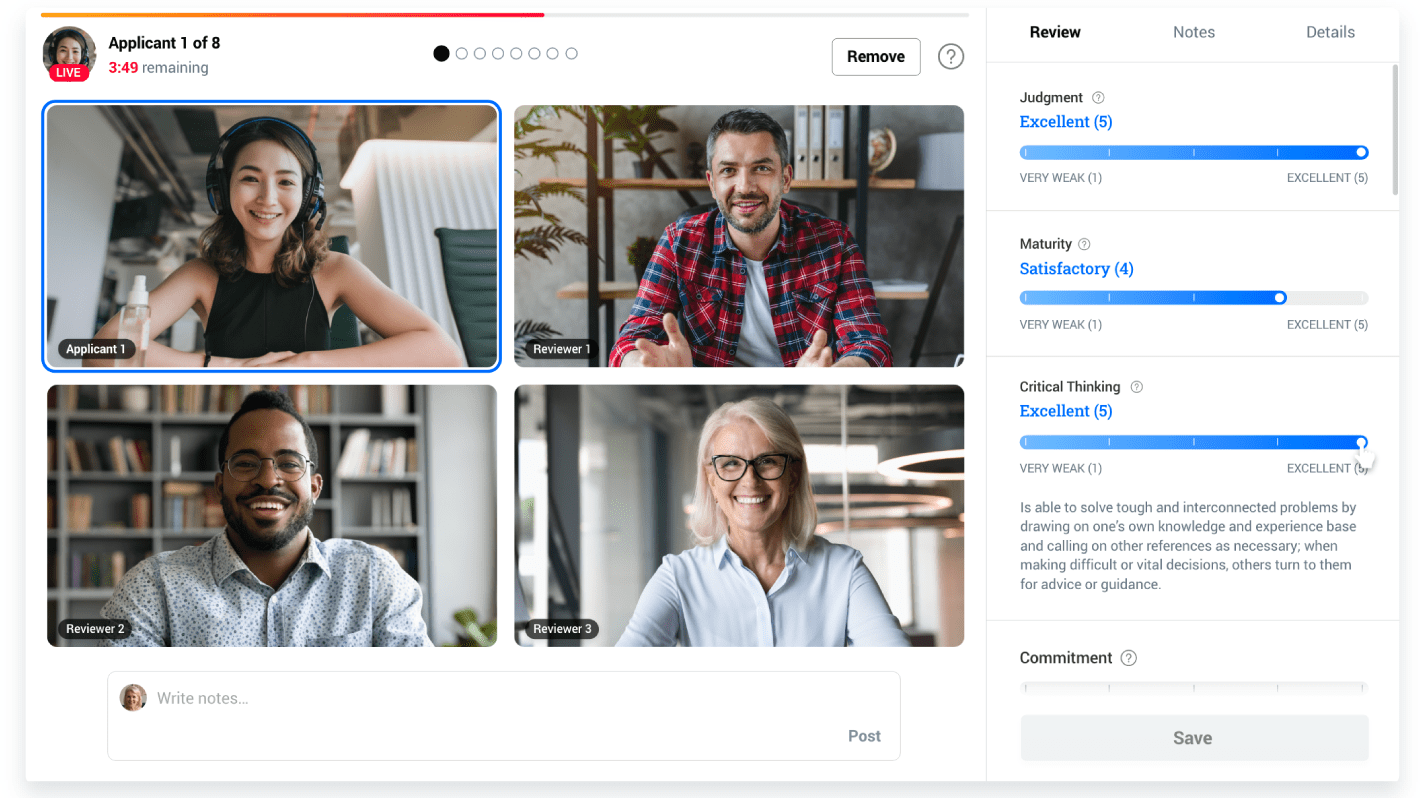
Other programs may place greater importance on real-time interaction, particularly when they want opportunities for discussion or follow-up questions. Kira's Live Interviewing solution supports structured one-on-one, panel, and Multiple Mini Interviews (MMIs), bringing interview delivery and scoring into one platform. This allows institutions to preserve the elements of live interviewing that matter most to their admissions process while simplifying how interviews are organized and evaluated.
For programs where reviewer availability is the primary constraint, Kira's Reviewer Services can provide additional trained reviewers to evaluate customized asynchronous assessments using the institution's defined competencies and rubrics. This gives programs another option for managing high-volume review periods without placing the entire evaluation workload on their existing faculty and staff.
These approaches aren't mutually exclusive. A nursing program might introduce asynchronous assessments earlier in the admissions process and reserve live interviews for a smaller group of applicants, while another might maintain its existing interview format and focus on improving how reviews are assigned. Kira works with admissions teams to determine the combination of assessments, workflows, and reviewing support that makes the most sense for their program, rather than applying the same model to every institution.
Making room for faculty expertise and applicant accessibility
A more flexible admissions process can benefit applicants as well as reviewers. At Washington State University's College of Nursing, traditional in-person interviews presented challenges across a multi-campus system. Applicants traveling from outside the state or balancing jobs and family responsibilities could find it difficult to attend interviews at fixed times, while the admissions team faced the administrative demands of coordinating participation.
Working with Kira, Washington State introduced asynchronous assessments that allow applicants to complete interviews during a designated assessment window. The college also adopted horizontal review for its BSN program, with two reviewers evaluating each competency rather than having one reviewer assess every aspect of an applicant's interview. These changes made it easier to organize faculty responsibilities while giving applicants more flexibility in how and when they could participate.
Read how Washington State University built a more inclusive nursing admissions process.
The University of Cincinnati College of Nursing faced a related challenge. Its reviewing team includes faculty, staff, clinical partners, and alumni, making it difficult to coordinate full days of in-person interviews. Working with Kira, Cincinnati introduced a more flexible interview and review process, including horizontal review that allows reviewers to focus on specific competencies across applicants. The college has reported improvements in reviewer recruitment and retention, alongside broader access for applicants who previously faced geographic barriers.
Explore the University of Cincinnati's admissions approach.
Both examples demonstrate the value of considering the full admissions experience rather than focusing exclusively on how interviews are delivered. By examining the needs of applicants, faculty, and admissions administrators together, programs can identify opportunities to make evaluation more accessible, consistent, and manageable for everyone involved.
Making meaningful interviews sustainable
For nursing programs considering changes to their admissions process, the goal is to create opportunities for meaningful evaluation while making responsible use of faculty time. That starts with understanding what applicants need to demonstrate, where faculty expertise is most valuable, and which assessment methods can help teams gather that information effectively.
For some programs, this may mean introducing asynchronous interviews, while others may benefit from refining live interviews, changing review assignments, or adding reviewer support during peak periods. Kira brings the technology and admissions expertise to help institutions evaluate these options, build assessments around their goals, and continue improving their processes from one admissions cycle to the next.
With the right approach, nursing programs can make more room for meaningful applicant interviews while keeping the process manageable for the faculty and staff who make them possible.
Explore what's possible for your nursing program
Whether you're introducing interviews for the first time or rethinking an established process, Kira's team can help you find an assessment and review approach that works for your program.
Explore Kira Talent's solutions for health professions admissions.