

January through March can feel like a marathon for admissions teams. Calendars fill. Conversations blur together. Debrief meetings stretch long into the day.
What’s less visible is the true cost of parent interviews – not in dollars, but in staff time. Scheduling, preparation, documentation, scoring, and discussion often consume as much time as the conversation itself.
Reducing that burden isn’t only about improving efficiency. When teams are stretched thin, consistency can slip, fatigue sets in, and it becomes harder to evaluate each family with the same care and attention.
This guide breaks down where time is lost and outlines practical ways schools can reduce interview workload using structure rather than new systems – preserving both staff capacity and fairness across families.
The hidden time cost of parent interviews
On paper, a parent interview might appear simple – a 30-minute meeting. In practice, each one carries significant operational weight.
The real time per family
A typical parent conversation includes:
- 5–10 minutes – Scheduling and coordination
- 20–30 minutes – Live conversation
- 10+ minutes – Notes, scoring, and debrief
Total: 35–50 minutes per family
For schools interviewing 150–300 families, parent conversations alone can consume 90-250+ staff hours per admissions cycle.
“What feels like a 30-minute conversation is often nearly an hour of total staff time.”
Where time is lost
The challenge lies in small inefficiencies embedded in long-standing processes.
Common interview inefficiencies:
- Scheduling back-and-forth
- Conversations running over time
- Off-topic drift
- Inconsistent interviewer styles
- Manual note rewriting
- Multiple reviewers per family
- Fatigue slowing scoring
- Lengthy debrief discussions
Individually, each issue may seem minor. Together, they can add dozens – sometimes hundreds – of extra staff hours per cycle while making it harder to ensure consistent evaluation across families.
Five time-saving tactics (no new technology required)
Meaningful improvements don’t always require new platforms. Many schools have streamlined their process by tightening structure around what already exists – improving efficiency while supporting fair, consistent decision-making.
1. Standardize to four core questions
Limiting interviews to 4 consistent, high-impact questions helps:
- Keep conversations within 20 minutes
- Ensure fairness and comparability across families
- Reduce interviewer improvisation
- Surface meaningful insights without rambling
High-impact questions aren’t necessarily more difficult – they’re more intentional. Effective prompts are focused, specific, and designed to reveal how families think, support their child, and engage with school communities. Many schools align these questions with their mission and values to better identify families who will thrive in their environment.
For example:
“Tell us about a time when your child faced a challenge or setback. How did you support them, and what did that experience teach you about your role as a parent?”
“What do you believe is the most important role a parent should play in a child’s education? Please share a specific example.”
Determining your school's "core four" interview questions ensures every family has an equal opportunity to share meaningful experiences — and gives admissions teams insight that is easier to compare when decisions become complex.
2. Use a “guardrail script”
Simple transition phrases help redirect conversations while maintaining warmth:
- “That’s helpful context – let’s shift to…”
- “To ensure fairness across families, I’d like to ask…”
Guardrails prevent drift without making the interaction feel scripted or impersonal.
3. Implement a simple 4-point rubric
A streamlined rubric:
- Clarifies evaluation criteria across interviewees
- Aligns reviewers around shared expectations
- Reduces post-interview debate
- Supports more defensible decisions
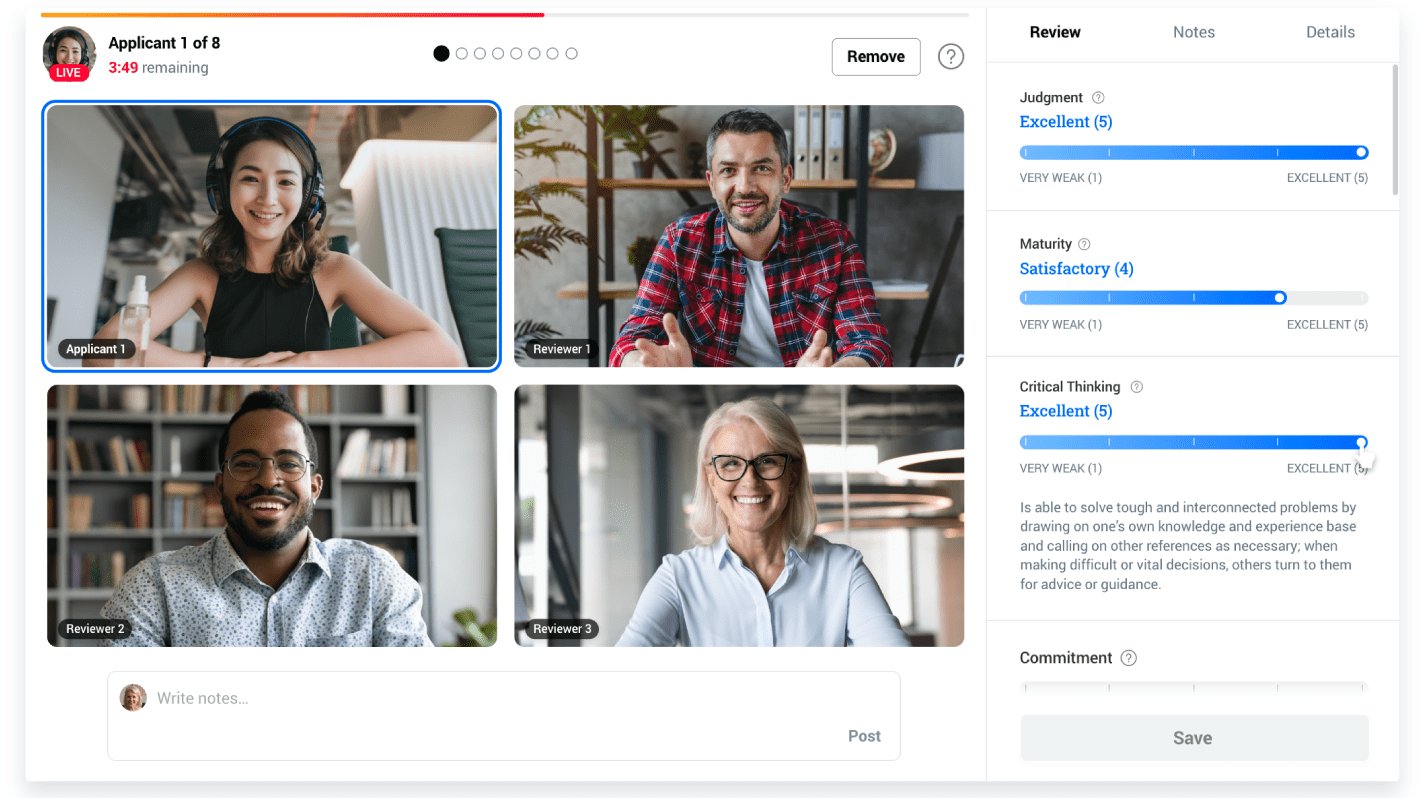
Rather than relying on intuition, many teams define three or four qualities they are listening for – such as partnership, reflection, judgment, or clarity – and describe what limited, emerging, clear, and strong responses look like in practice. The goal isn’t technical scoring, but helping interviewers distinguish stronger signals from weaker ones using the same lens for every family.
Approaches like this reflect competency-based evaluation models used in many admissions processes, where rubrics are aligned directly to the qualities a school hopes to assess. When expectations are defined in advance, debrief conversations become shorter, more focused, and less subjective.
4. Consider a single-interviewer model
Many schools default to two or three interviewers per family. Moving to one interviewer – with optional second review for borderline cases – can:
- Reduce total staff time significantly
- Simplify scheduling
- Minimize coordination fatigue
- Maintain consistency when supported by a clear rubric.
5. Use a standardized notes template
A structured template helps interviewers capture what matters most:
- Prevents rewriting notes later
- Focuses attention on evaluative criteria
- Shortens debrief discussions
- Encourages active listening during the conversation
Clear documentation also makes it easier to compare families consistently when decisions become difficult.
What schools are reporting
Independent schools that introduce more structure into their interview process often report:
- More consistent interview lengths
- Stronger scoring alignment
- Fewer reviewers required
- Shorter decision discussions
- Greater confidence in final decisions
For example, Crystal Springs Upland School in California found that adding structured components improved the depth and clarity of insights gathered from families while reducing interviewer fatigue and bottlenecks.
Some schools also experiment with asynchronous elements to further reduce review time, though operational improvements alone can yield substantial gains.
When schools revisit their interview structure
Admissions teams tend to reassess processes at predictable moments:
- After the parent response deadline
- During March Break
- Post-cycle debrief meetings
- Summer retreats
- Early fall planning sessions
These windows are ideal for evaluating whether the current approach is sustainable – and whether it supports consistent, equitable evaluation of families.
"The best time to redesign your interview process is immediately after the cycle ends–when the friction is still fresh."
Planning smarter for next year
Reducing parent interview workload is about protecting staff time while maintaining a thoughtful, high-quality experience for families and producing insights that are genuinely useful in decision-making.
Small structural adjustments – tighter prompts, clear guardrails, and a simple rubric – can significantly reduce calendar strain while improving consistency and clarity across the review process.
If you make one change:
Pilot four standardized questions and a four-point rubric for a short period (for example, the first two weeks of interviews). Even this small shift can create immediate time savings and more comparable data across families.
Admissions teams reviewing next year’s process may benefit from mapping where time is actually spent today – then identifying what should remain live, what can be standardized, and what may be creating more workload than value.
Some schools also explore structured assessment approaches or dedicated platforms designed to support consistent, efficient evaluation. Kira Talent, for example, works with independent schools to help make parent interviews easier to conduct, fairer to evaluate, and more useful in admissions decision-making.
