



Growing fast, without losing what makes Elon, Elon
Elon University's Physician Assistant program is one of its most competitive: roughly 2,000–3,000 applications each cycle for just 36 seats, with an average incoming GPA of 3.6 and about 5,000 hours of healthcare experience per candidate. Historically, review ran on a 20-month cycle, and every single file was evaluated manually, by hand, against the same rubric — a level of commitment the admissions team takes seriously.
That commitment collided with an ambitious growth plan. Elon set out to double the program's cohort from 36 to 76 seats and, working with its accrediting body, needed to compress its 20-month review cycle down to just 8 months to do it responsibly.
"[We had] a lot of factors that were... challenging," said Alexandra Duffney, Dean of Graduate Admissions. Faculty were already stretched thin running the existing interview process; doubling volume in a fraction of the time risked burnout, inconsistent decisions, and — for a school that prides itself on being "relationship-rich" — an interview experience that lacked Elon’s personal touch.
Elon considered simply scaling up its existing in-person interview model and also explored a hybrid orientation-plus-scheduled-interview format. Both ran into the same wall: faculty availability. "It would also really be difficult for our faculty to reserve that much time over the summer," Duffney explained.
Why Reviewer Services was the best solution to scale while retaining personal connection
Trusting evaluation to an external service raised real questions for Elon's team: Would asynchronous video essays feel too impersonal for a school built on relationships? Would outside reviewers, unfamiliar with Elon's program and faculty, actually agree with how Elon's own faculty would score the same file? "The thing that made us pause was this idea of having an impersonal interview experience," Duffney said.
The answer to both, ultimately, came down to trusting human judgment over automation.
"We wanted to commit to humans evaluating the files. The ability to use human judgment rather than written technical rules that are very linear was important to us. It aligns with our relationship-rich community — it's something we take a lot of pride in."
–Alexandra Duffney, Dean of Graduate Admissions, Elon University
Elon built in a safeguard, too: any case without a clear consensus would go to an additional faculty member as a tiebreaker.
To preserve the relationship piece, Elon shifted its in-person energy toward the other end of the funnel — building dedicated yield events, faculty panels, and community-connection sessions for admitted students, rather than trying to pack relationship-building into the interview stage itself.
Setting Elon up for its next chapter of growth
The partnership launched fast: Elon signed its contract in April and was live by June. Once underway, the results were dramatic. As scores began coming in, Duffney watched closely. "I felt really excited," she said. "I realized quickly that this is definitely the right solution for us."
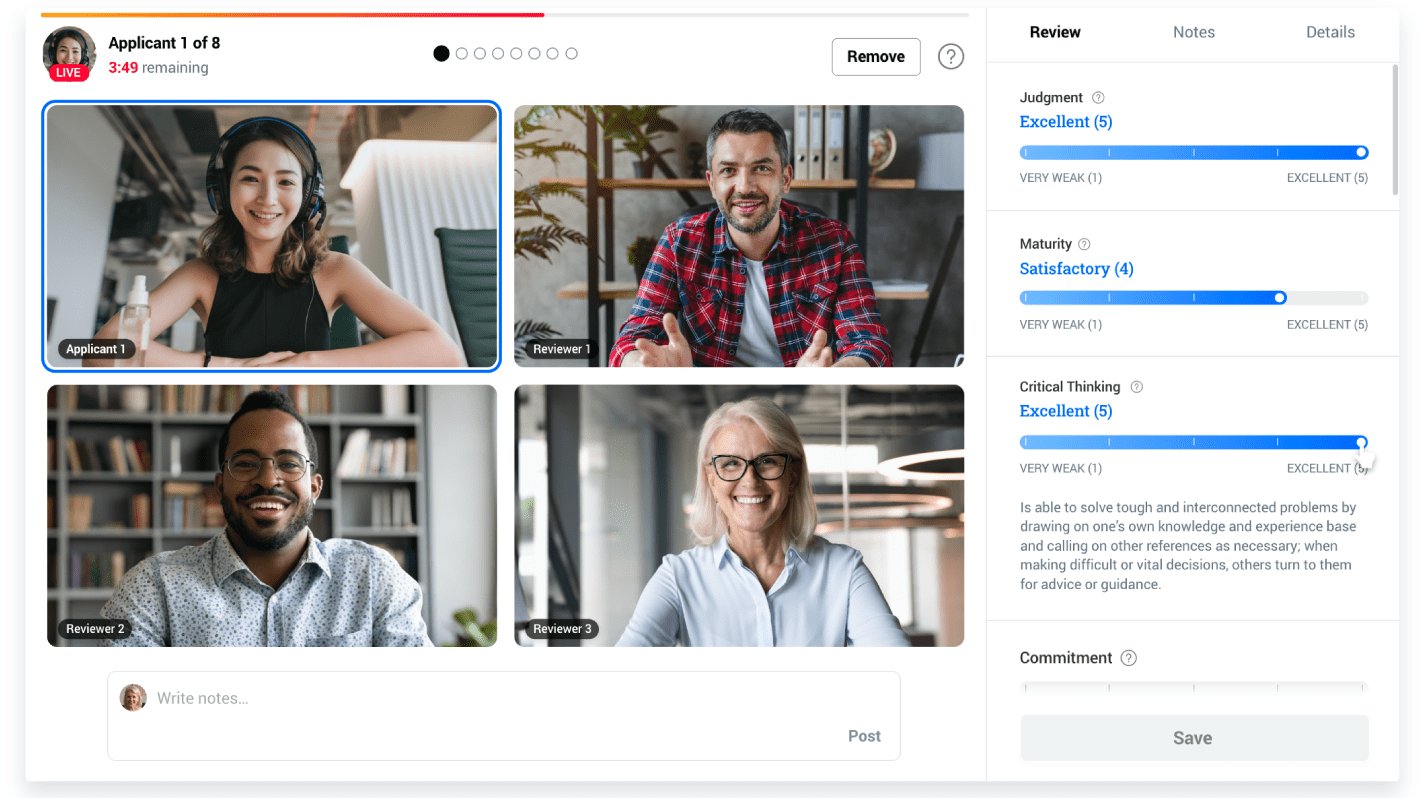
Elon conducted roughly 450 interviews in a single cycle — more than triple its historical max of 130–150 — while compressing the full review-to-decision timeline from 20 months to 8. Ten faculty members handled video essay evaluations at an estimated 8–10 minutes per review, roughly 5–5.5 hours per faculty member across the cycle, fitting the work around their own schedules rather than fixed interview-day blocks.
The number Duffney keeps coming back to, though, is consistency: of the 450+ files evaluated, only 19 required a second faculty reviewer to resolve a discrepancy — better than 96% inter-rater reliability. "That was a real confidence booster," she said. "In terms of morale, in terms of investment, in terms of willingness to partner and continue with these evaluations while enduring growth — it's difficult to quantify, but it is so very important for us."
Faculty adoption was smooth, too. "They were so completely supportive of the Kira interface," Duffney said, citing the video replay feature — useful for pre-cycle calibration training — and the platform's overall ease of navigation as standouts.
What's next
Elon is now expanding the model to a brand-new Physician Assistant cohort of 76 students at a regional campus in Charlotte, North Carolina — using the same Reviewer Services partnership to scale without adding headcount. Elon is now also looking to automate parts of its workflow, including invitation triggers and score mapping into its CRM, to reduce manual lift even further.
"This has been one of the most significant decisions that we have made in our admissions process," Duffney said. "It has allowed us to not only double the size of this cohort, but maintain the same staff size relatively, and also offer a whole separate program in Charlotte... If we were not doing that, we would not be able to facilitate that enrollment without a substantial increase in staff."
Her advice to a peer institution considering the same move is candid: "I have found this to be such a dynamic and valuable resource for us, so I would be happy to connect with anyone seeking a firsthand perspective on how Reviewer Services can support their institution and help inform their decision to move forward. I am so pleased with the decisions that we've made, and I'm really looking forward to continuing partnerships with Kira.”