



How Asynchronous Assessment keeps pace with rolling admissions
MUSC's hybrid PT and OT programs developed side by side, and both lean on rolling admissions within a defined application window. Kira’s Asynchronous assessment helps keep pace with that rhythm. As soon as an application is complete, the admissions teams can run an initial review, extend an interview, and route the completed interview straight to committee – no batching or waiting for a cutoff date.
"With the rolling admissions process, as soon as we get applications submitted and completed, we can start reviewing them, do an initial review, and see if that's an applicant that we want to extend an interview to," Wilhelm said.
The process drove a turnaround similar programs often can't match. "From the time that someone submits their completed application... it can be two weeks before they get a decision," Wilhelm said, "whereas most programs that have a hard deadline... an applicant may wait 3 or 4 months before hearing any type of decision." Scanlon called it "a very quick process, a very quick turnaround time — which is kind of unusual in these programs."
Kira is built for hybrid, faculty-everywhere programs
With PT and OT faculty distributed nationally, in-person interviews weren't practical. Flying faculty and applicants in would have been expensive and time-consuming. But neither program wanted to skip an interview altogether. "We felt like interviewing was an important part of the admissions process for physical therapy," Wilhelm said, and Scanlon agreed the format "really supports us. Our faculty is all over the country, so this made a lot of sense for us."
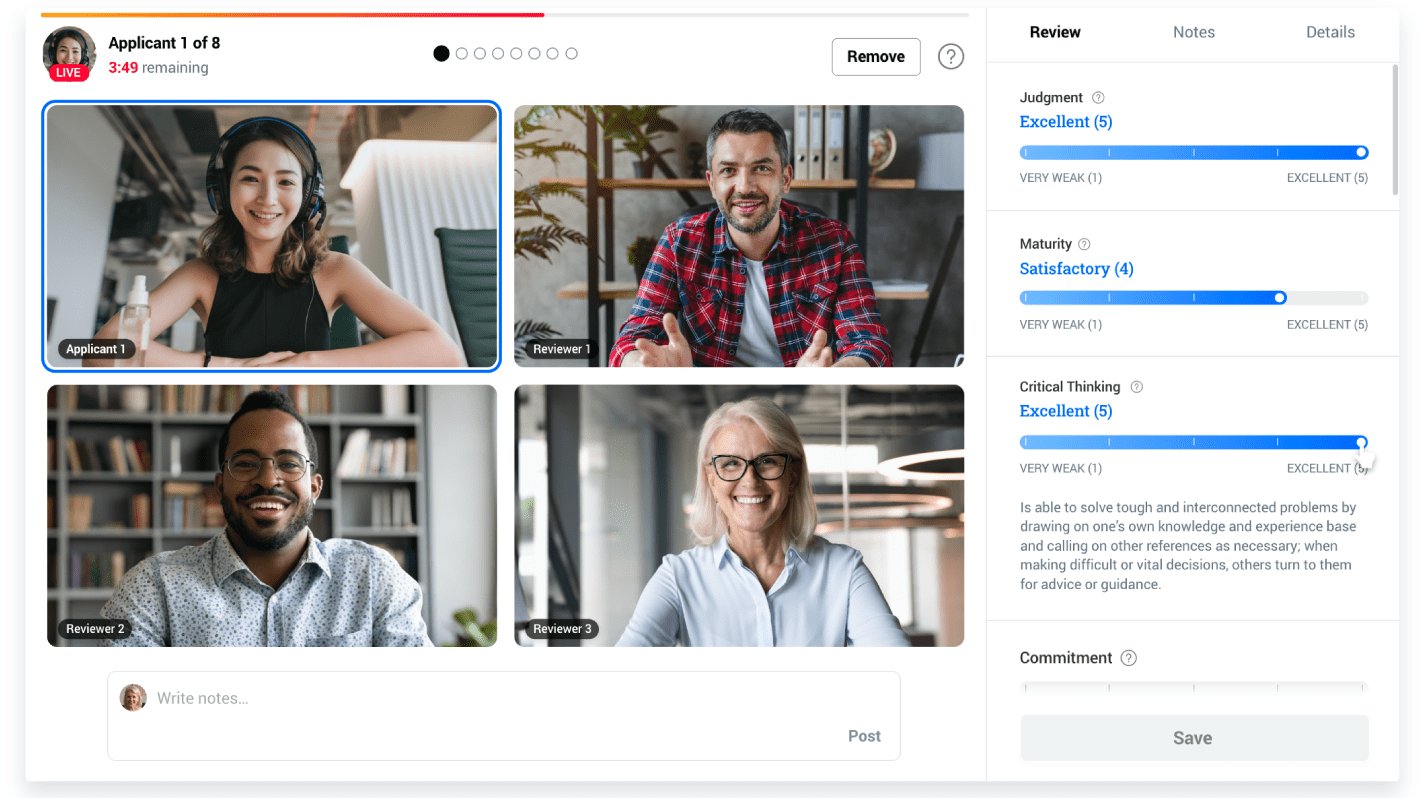
Reviewing is fast once faculty get comfortable with the platform. "I love having the rubric right next to the videos," Wilhelm said, "because as you're watching the video, you click on the number, and it automatically goes into the scoring component." Most faculty complete a review in 10-15 minutes.
Because there's no need to coordinate live interview times, decisions move quickly on the front end too. Wilhelm described reviewing two applicants and sending interview invitations in "5 minutes or less” before a call – no scheduling or back-and-forth. Applicants often complete interviews outside of business hours, at their convenience rather than relying on his team's availability.
Completion rates outpace in-person interviews
Because both coordinators started their roles alongside the implementation of Asynchronous Assessment, there's no pre-Kira baseline to compare against directly. What is measurable is applicant behavior: PT's completion rate rose from 90% in year one to 96% in year two. Wilhelm attributes much of that to the platform itself – applicants get up to 10 days and can record whenever it works for them. "They don't have to travel... they can do it at 5 in the morning if they're a morning person, or 10 or 11 or 12 at night if they're an evening person," he said, "and then we can review it on our own time," which he sees as a major driver of both completion and review efficiency.
Kira allows the flexibility to bring in extra reviewers – or revisit a decision later
Every applicant's interview is reviewed by two admissions committee members and having it on video means a third reviewer or the program director can weigh in on any applicant whose scores diverge – seeing the exact same interview, not a secondhand account.
"Whereas if you're doing live interviews, the opinion of the two people that saw the interview is all you have. You can't go back and watch it again," Wilhelm said.
Consistency and fairness by design
Kira’s randomized question sets mean applicants draw from a pool of questions within chosen behavioral domains rather than all seeing an identical script. "I like that it randomizes the questions for the applicant, so not every applicant gets the same exact question set," Wilhelm said. It safeguards against questions circulating among applicants ahead of time.
Room to grow with Kira
MUSC's hybrid PT program was the first at the university to adopt Kira, and Wilhelm expects applicant volume to keep climbing substantially over the next few years as awareness of the hybrid format spreads. Other programs at MUSC have since adopted or are actively exploring Kira, with Wilhelm fielding questions from colleagues setting it up for the first time.
"We knew what we wanted at the beginning and went with it, as opposed to struggling for 2 or 3 years first and then figuring it out," Wilhelm said. If we didn't have it, things would be a lot more difficult.” "We'd have to find a lot of different ways to try to get things done, and it would not be nearly as efficient, he added."
Advice for admissions leaders
Wilhelm's advice for a skeptical peer is straightforward: look at the numbers. Faculty aren't scheduling one-on-one time with every applicant, applicants aren't traveling, and a 96% completion rate speaks for itself. Compared to coordinating live interviews – finding common availability, then holding a 15–30 minute conversation per applicant – Kira lets applicants complete an interview in about 15 minutes and reviewers assess it in 10-15, cutting the time investment roughly in half.
Scanlon put it plainly:
"We would be very unhappy if we had to give up Kira. It's an easy process, we're able to be really efficient at it, and it doesn't feel like a burden."