
If you're exploring asynchronous assessment for your program, here's what you can expect.
From implementation through to the applicant, reviewer, and administrator experience.
Many admissions teams already have a structured interview process they're confident in. Their interview questions are established, reviewers are trained, and scoring rubrics are in place. As application volumes grow, however, coordinating interviews often becomes one of the most time-consuming parts of the admissions cycle.
That's especially true for programs that rely on faculty members, practising clinicians, or external reviewers. Finding interview times that work for everyone – while keeping the admissions process moving for applicants – can quickly become a logistical challenge.
Asynchronous assessment gives institutions another way to deliver structured interviews. Existing interview questions, competency frameworks, and scoring rubrics can all remain in place, while applicants and reviewers gain greater flexibility in how and when assessments are completed.
Building on the admissions process you already have
One concern we hear regularly is whether moving to an asynchronous assessment means redesigning an existing interview process. For most programs, that's not the case.
Existing question banks, competency frameworks, structured interview formats, and evaluation rubrics typically transfer into Kira with only minor refinements. During implementation, our team works with each institution to configure an assessment that reflects the admissions process they've already built rather than asking them to start over.
That allows admissions teams to continue evaluating the same qualities they value today while simplifying how assessments are delivered.
Setting applicants up for success
Every admissions process begins by setting clear expectations for applicants.
Each applicant receives a unique assessment link tied to their invitation. Before beginning, they can review exactly what the assessment includes—from the number of video and written questions to the estimated completion time, preparation and response times, submission deadline, and technical requirements. Programs can also customize the assessment name, branding, and messaging so the experience feels like an extension of their institution.
Most institutions choose to include a welcome video from their admissions team. It's a simple way to introduce the assessment, reinforce the program's brand, and explain what applicants can expect before they begin.
Rolling deadlines are another option many programs appreciate. Rather than asking every applicant to complete an assessment on the same day, institutions can give applicants a set amount of time – such as one week from receiving their invitation – to complete the assessment, creating greater flexibility throughout the admissions cycle.
Giving applicants an opportunity to prepare
Another question we hear often is how applicants adapt to an asynchronous interview format.
The experience is designed to remove as much uncertainty as possible before responses count.
Applicants begin with a guided check-in process that confirms their camera, microphone, and internet connection are working properly. They then complete a practice assessment that mirrors the live experience, allowing them to experience preparation timers, response windows, and transitions between questions before beginning the assessment itself.
Programs can also request supplemental materials during check-in, such as confidentiality agreements or additional documentation, keeping everything together in a single workflow.
Delivering a structured assessment
Once the assessment begins, applicants move through a structured interview built around the competencies your program wants to evaluate.
In Kira, assessments are organized by competency rather than simply by interview question. Whether you're assessing communication, compassion, professionalism, critical thinking, or another attribute, each competency can have its own bank of questions and associated scoring rubric. This allows admissions teams to evaluate applicants consistently while tailoring the assessment to their program's priorities.
Programs can combine timed video responses with written responses depending on their admissions goals. Preparation time, response time, transition periods, and question order can all be configured to support the interview model already in place.
Competency-based question banks also provide additional flexibility. Rather than presenting every applicant with the exact same question, programs can randomize questions within a competency. For example, a communication competency might include several different prompts, while every applicant is still evaluated against the same criteria. This helps maintain a consistent assessment framework while reducing opportunities for question sharing.
Most institutions also choose to record their own interview questions. Having faculty members or admissions staff appear throughout the assessment creates a more personal experience while ensuring every applicant receives a structured, consistent interview.
Supporting fair, consistent review
Consistency remains just as important after applicants submit their assessments.
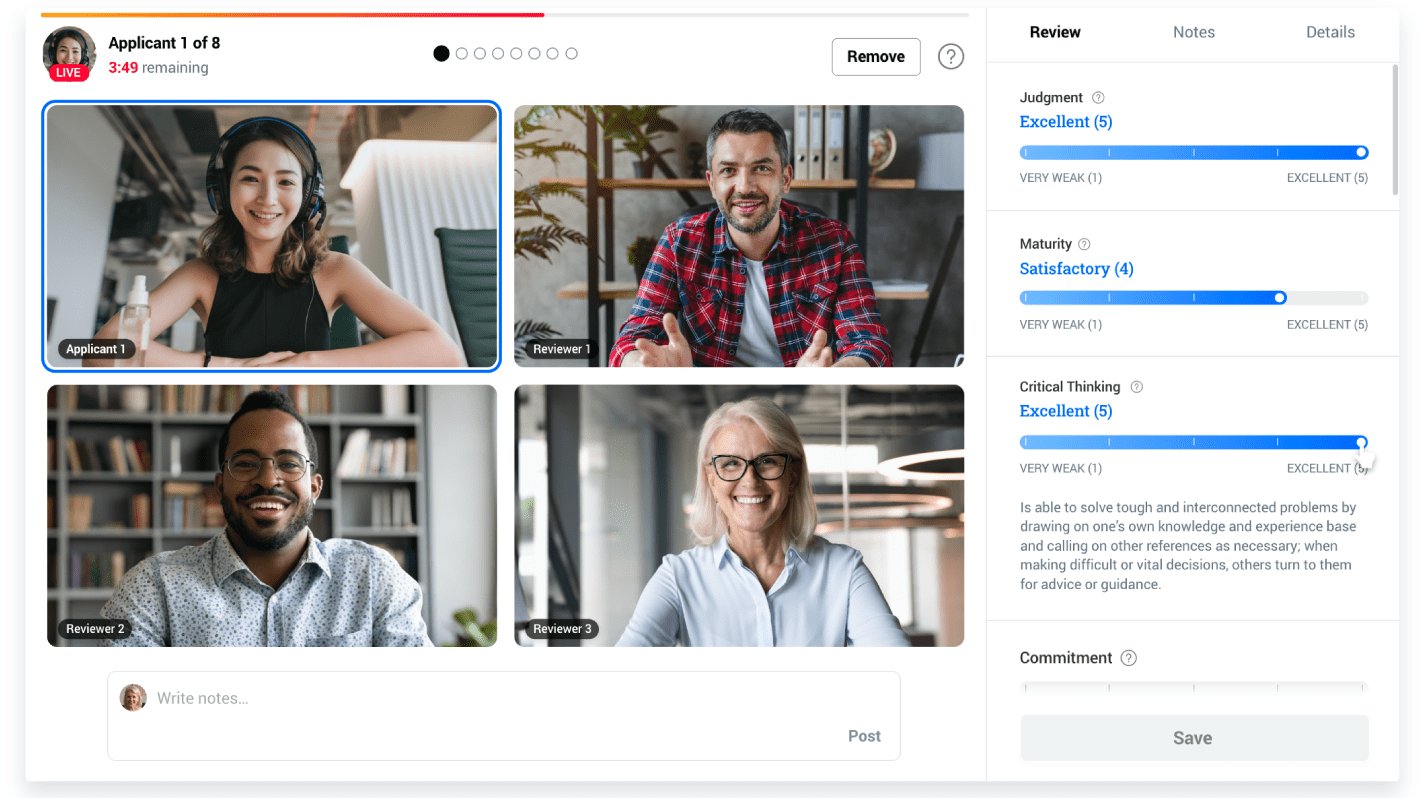
Reviewers evaluate responses using standardized rubrics aligned to clearly defined competencies. Depending on the admissions process, reviewers can assess an applicant's complete interview or focus on specific competencies, making it easier to involve faculty members, clinicians, or external reviewers throughout the admissions cycle.
Many programs also use passive rubrics to capture broader observations that aren't tied to a single interview question, such as communication skills or behaviours that warrant additional discussion during committee review.
Advanced Applicant Integrity Insights
Supporting fair admissions decisions also means giving reviewers the right context throughout the assessment process.
Kira's new Admin Platform introduces Advanced Applicant Integrity Insights, providing admissions teams with additional context about applicant behaviour during an assessment. Rather than presenting a single integrity flag, these insights help administrators understand the sequence of events that occurred while an applicant completed their assessment.
Examples of tracked behaviours include:
- Leaving and returning to the Kira browser tab
- Copying question text
- Pasting written responses
- Device changes
- Browser refresh anomalies
- Typing speed anomalies
- Technical issues encountered
Each event includes additional context, allowing admissions teams to better understand what occurred and when it happened during the assessment. These insights are designed to support human decision-making by providing reviewers with more information as they evaluate each applicant – they don't make admissions decisions on behalf of your team.
To learn more about these enhancements, read our blog introducing Kira Talent's New Admin Platform.
Making review more flexible
Reviewer flexibility is another area admissions teams frequently ask about.
Because applicants and reviewers no longer need to be available at the same time, reviews can begin as soon as assessments are completed. Institutions can distribute work across the admissions cycle rather than concentrating interviews into a handful of days, making it easier to involve busy faculty members and reviewers when their schedules allow.
Administrators can assign reviewers by applicant or by competency, monitor review progress, send reminders, and compare reviewer scoring trends over time. These insights support reviewer calibration and help admissions teams maintain consistency across the review process.
Greater visibility for admissions teams
Asynchronous assessment also changes how admissions teams manage the review process behind the scenes.
Administrators can monitor applicant progress from invitation through completion, see which applications are ready for review, track reviewer workloads, and understand where each applicant is within the admissions pipeline. Rather than relying on spreadsheets or manual follow-up, teams have a centralized view of the entire process.
Reviewer dashboards also make it easier to understand review progress across the admissions cycle, while scoring reports help identify opportunities for reviewer calibration and ongoing training.
Looking ahead
Every admissions process is unique. Some programs interview a few dozen applicants each year, while others are coordinating thousands of assessments across multiple reviewers and campuses.
Asynchronous assessment gives institutions another way to deliver structured interviews without changing what they're evaluating. Existing questions, competencies, and scoring rubrics remain at the centre of the admissions process, while applicants, reviewers, and admissions teams gain greater flexibility throughout the cycle.
For many programs, that means spending less time coordinating interviews and more time focusing on what matters most: getting to know applicants and making informed admissions decisions.