
For admissions teams, growth presents both a challenge and an opportunity.
As your program gains popularity and applications multiply, there comes a point where reviewing every applicant through a traditional live interview process is no longer sustainable. Faculty time is limited, schedules become more difficult to coordinate, and the administrative burden of interviewing hundreds of applicants can quickly become overwhelming.
However, many schools are hesitant to move away from live interviews altogether. Real-time interactions provide valuable opportunities to evaluate communication skills, ask follow-up questions, and gain a deeper understanding of how applicants think and respond in the moment.
As one admissions leader shared:
"The only concern about an asynchronous video interview is that I don't get to really interact with the candidates. I can't really do the small talk chatting, which is part of the interview as well, sure to kind of test their communication and body language skills."
It's a valid concern. Live interviews provide insight that can be difficult to capture through an application or async alone.
At Kira Talent, we believe admissions teams shouldn't have to choose between efficiency and meaningful applicant interaction. That's why many programs are adopting a hybrid approach – using asynchronous assessments to evaluate applicants at scale, then inviting a smaller group of finalists to participate in live interviews. The result is a more sustainable admissions process that preserves opportunities for real-time connection while helping teams make informed, holistic admissions decisions.
Queen's University School of Medicine scaled admissions without losing human connection
Queen's University School of Medicine faced a challenge familiar to many admissions teams: how do you make your process scalable without losing the meaningful applicant interactions that live interviews provide?
Their Kira solution was a two-stage admissions model.
More than 500 applicants first complete an asynchronous Multiple Mini Interview (MMI), allowing the admissions team to hear directly from every applicant and evaluate key competencies in a structured format. Approximately 300 applicants then advance to a live panel interview, where reviewers can engage in real-time conversations and explore how applicants think and respond in the moment.
As Kelly Moore, Admissions Manager at Queen's University School of Medicine, explained:
"We're not just looking at what we see on paper. We want to interact with these applicants, we want to see how they think and act on their feet."
The asynchronous assessment helps Queen's identify which applicants should move forward to the next stage of review. The result is a process that allows the team to evaluate more applicants while preserving opportunities for meaningful interaction with finalists.
How Asynchronous Assessments and Live Interviews complement each other
One of the biggest misconceptions about asynchronous assessments is that they're designed to replace live interviews.
In reality, the two formats serve different purposes.
Asynchronous assessments help admissions teams hear directly from every applicant in a structured, standardized format. Rather than relying solely on application materials, reviewers gain additional insight into an applicant's communication skills, critical thinking, professionalism, and readiness for the program. Because assessments can be completed and reviewed on demand, admissions teams can evaluate larger applicant pools without the scheduling challenges that come with live interviews.
For Queen's Psychiatry Residency, asynchronous assessments became an effective way to evaluate applicants early in the admissions process. Applicants first completed an asynchronous Multiple Mini Interview (MMI), allowing reviewers to identify strong candidates before inviting finalists to participate in a live panel interview.
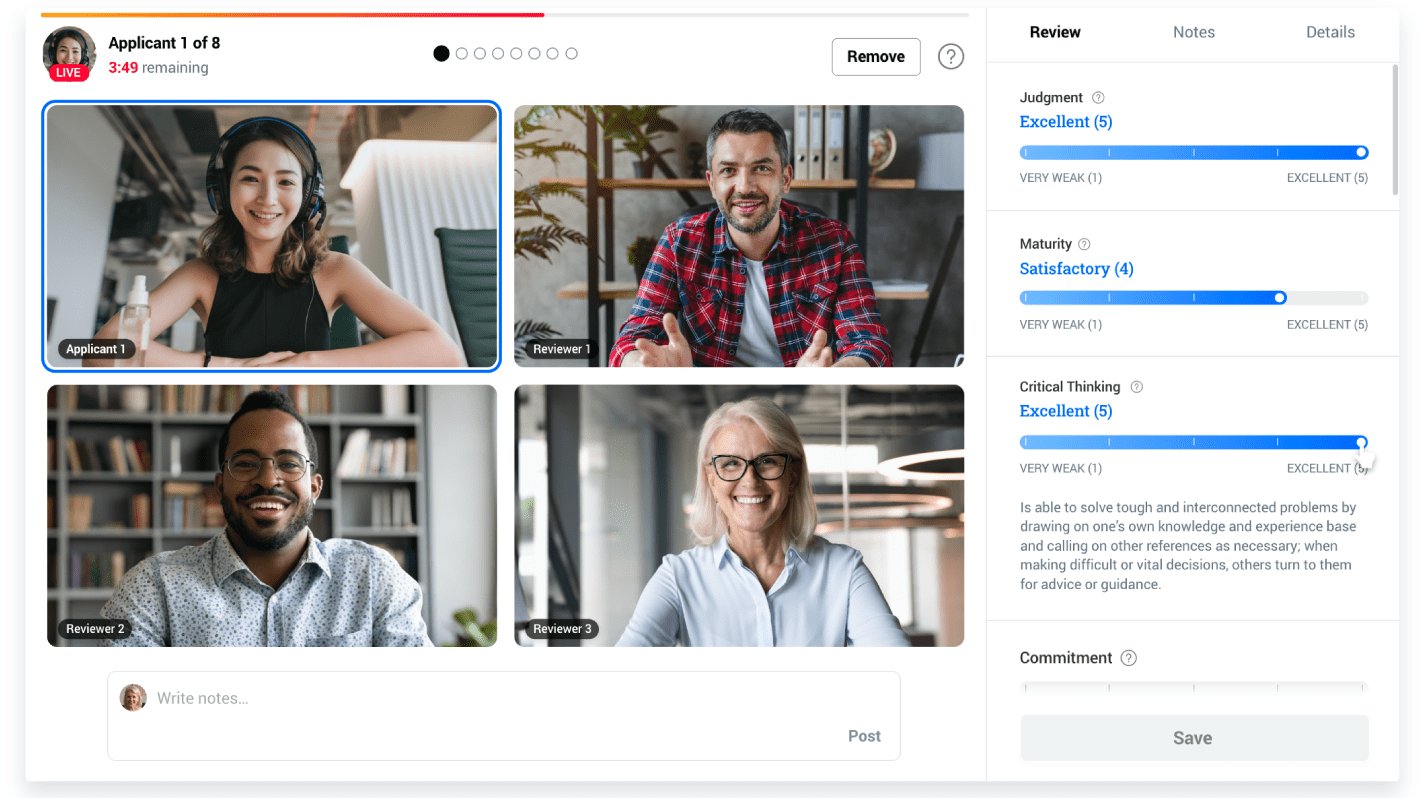
Live interviews, meanwhile, provide opportunities to go deeper. Reviewers can ask follow-up questions, explore areas of interest in greater detail, and observe how applicants respond in real time. These conversations often play an important role in assessing program fit and building connections with prospective students.
The University of Waterloo School of Pharmacy adopted a similar phased approach when it replaced its in-person interview weekend with a virtual admissions process. By combining asynchronous assessments with live interviewing, the school was able to improve efficiency while maintaining meaningful interaction between applicants and reviewers.
As Kaitlin Bynkoski, the Director of Admissions & Undergraduate Affairs, shared:
"For our fundamental skills assessment, the flexibility that the Kira platform offered to applicants and reviewers was a huge benefit. And the real-time interviewing allowed us to maintain that face-to-face connection."
Together, asynchronous assessments and live interviews create a more complete picture of every applicant.
One platform for the entire admissions journey
One of the advantages of a hybrid admissions process is that it doesn't require admissions teams to manage separate tools for each stage of review.
With Kira, teams can conduct asynchronous assessments and live interviews within a single platform. Admissions teams can build structured evaluations around the competencies they value most, apply consistent rubrics throughout the process, and gather multiple data points before making final admissions decisions.
This unified approach also helps support fairness and consistency. Structured assessments, competency-based evaluation criteria, and standardized review processes help admissions teams focus on what matters most: identifying applicants who are the best fit for their program.
Scale admissions without losing valuable connection
Kira provides the flexibility to build an admissions experience that reflects your goals.
Schools like Queen's University School of Medicine, Queen's Psychiatry Residency, and the University of Waterloo School of Pharmacy show us that a hybrid approach can provide the best of both worlds: the efficiency and consistency of asynchronous assessments combined with the depth and connection of live interviews.
By using asynchronous assessments to evaluate applicants at scale and reserving live interviews for finalists, admissions teams can create a more sustainable process while still gaining the insights needed to make confident, holistic admissions decisions.