
Changing an established admissions process takes careful consideration.
Many admissions teams already have a structured interview process they're confident in. Their interview questions are established, reviewers are trained, and scoring rubrics are in place. As application volumes grow, however, coordinating interviews often becomes one of the most time-consuming parts of the admissions cycle.
That's especially true for programs that rely on faculty members, practising clinicians, or external reviewers. Finding interview times that work for everyone – while keeping the admissions process moving for applicants – can quickly become a logistical challenge.
Asynchronous assessment gives institutions another way to deliver structured interviews. Existing interview questions, competency frameworks, and scoring rubrics can all remain in place, while applicants and reviewers gain greater flexibility in how and when assessments are completed.
Concern #1: “Adding another platform will create more work for our team”
For a busy admissions team, adding another piece of technology can sound like adding another task to the list. But for some teams, introducing Kira has allowed them to replace steps they were previously managing manually or through scheduled interviews.
One healthcare admissions team saw this firsthand. The team told us its live interviews previously took 20 to 25 minutes. With the case study portion handled separately, those interviews could be shorter.
One faculty reviewer described the impact:
“It was a huge time saver.”
Instead of carving out hours for scheduled interviews, they could review applicant responses when their schedule allowed – even outside traditional working hours.
The team saw another benefit behind the scenes: fewer applicant support questions landing with admissions. After reflecting on the cycle, one administrator noted that they hadn’t received a single email from an applicant panicking about accessing or navigating the assessment:
“It worked because I didn’t get one email.”
A business school saw similar efficiencies after moving away from a process that required coordinating faculty and applicants around interview schedules. The team described its new process as “a lot smoother and also clearer” because it could establish a plan in advance without being as dependent on everyone’s availability.
Applicants had more flexibility, too. Instead of being available at a specific time for a live online interview, they had a defined window to complete their assessment. Practice questions also gave them an opportunity to familiarize themselves with the format before starting.
For teams evaluating Kira, it’s worth looking at both sides of the equation: the work involved in introducing something new and the work it could replace.
Scheduling interviews, coordinating faculty availability, supporting applicants, and managing other administrative steps all take time. Changing the process can give teams an opportunity to reduce some of that work.
Concern #2: “There will be a steep learning curve”
Admissions teams already work across plenty of technology. Adding a new platform can understandably raise questions about training and how quickly administrators and reviewers will become comfortable using it.
For one admissions professional, that concern extended beyond navigating Kira to actually building the assessment.
Their experience was different from what they expected:
“Even building the assessment was a lot easier than I expected. I was able to learn it very quickly.”
They also described the reviewer experience as “really easy” and the platform as intuitive.
We heard something similar from a healthcare program after its first cycle with Kira. Its faculty had initially been reluctant about the new platform, but the program administrator said they ultimately found it “easier than they expected.”
These experiences are consistent with what we’ve heard across other customer conversations. Administrators and reviewers at different stages of implementation have independently described Kira as intuitive and easy to navigate.
Part of the transition is also deciding what doesn’t need to change.
Programs don’t necessarily need to replace the questions, competencies, or evaluation criteria they’ve already developed. Existing interview questions and rubrics can often be adapted for use in Kira, with adjustments to elements such as timing and instructions where needed.
Kira’s Client Success team works with programs through assessment setup and implementation, helping teams apply their existing admissions goals and processes within the platform.
Your admissions expertise stays with your team. Kira provides a structured way to put it into practice.
Concern #3: “Getting faculty and reviewers on board will be difficult”
Admissions teams aren’t always the only people affected by a process change. Faculty, committee members, and other reviewers may all need to work differently.
Elon University experienced this when its Physician Assistant program considered moving from live interviews to asynchronous assessments.
Dean of Graduate Admissions Alexandria Duffney said there had initially been “a lot of hesitation about asynchronous,” particularly because Elon is a “relationship rich community.” The team had questions about what changing the format could mean for its connection with prospective students.
After the first cycle, however, Duffney said:
“I had overwhelmingly positive responses from faculty which was shocking to me.”
Duffney noted that the program had been “very resistant for a long time,” but faculty were impressed by the intuitive interface and consistency of the ratings.
Elon went on to conduct roughly 450 interviews in a single cycle – more than triple its historical maximum of 130–150 –while compressing its review-to-decision timeline from 20 months to eight. The program also grew its incoming cohort from 36 to 76 seats while maintaining roughly the same staff size.
Read how Elon University doubled its PA cohort with Kira →
We’ve heard a similar progression from another healthcare admissions team.
Kira had initially been a “hard sell” for its admissions committee. Reviewers had questions about how applicants would be evaluated and how scoring would work.
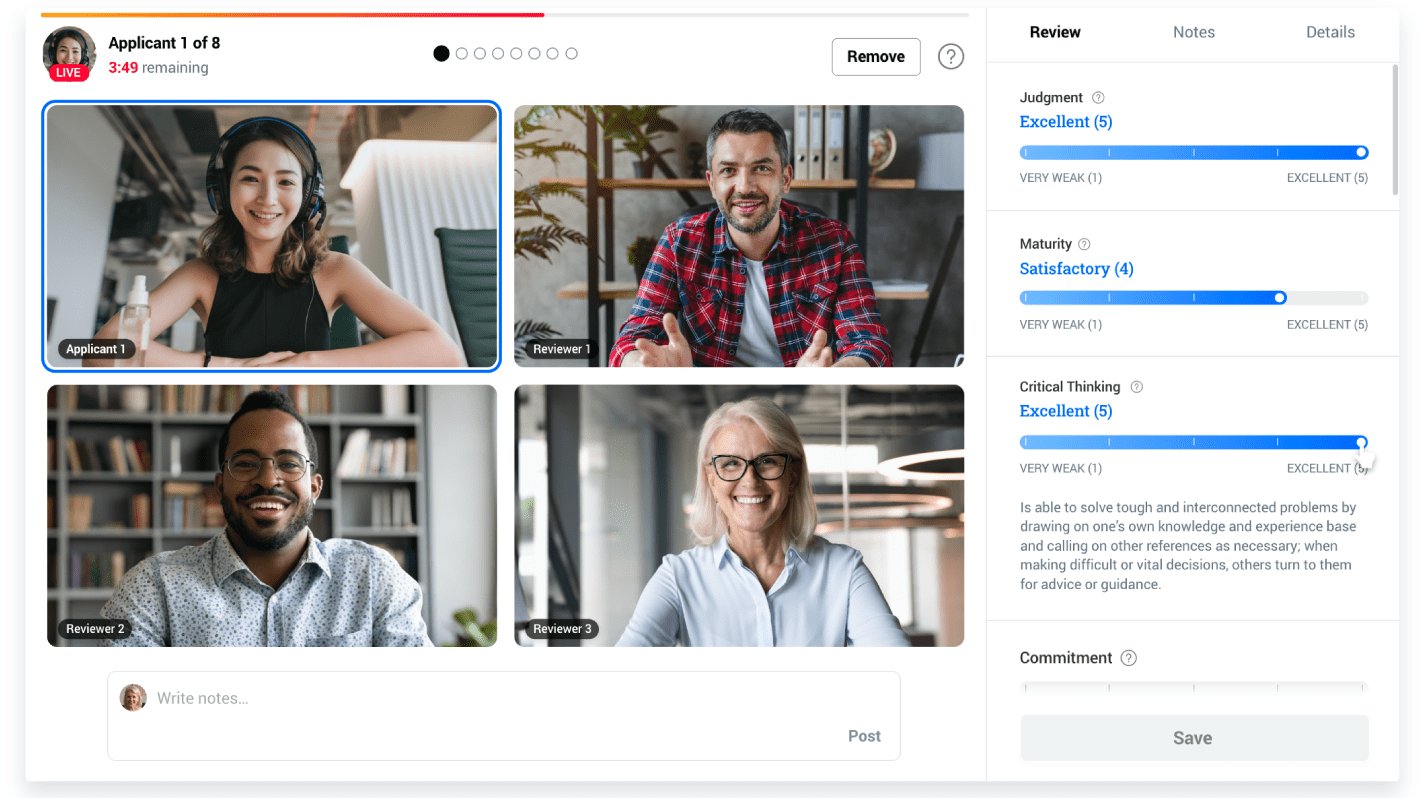
The team gave committee members an opportunity to watch applicant responses and compare their own evaluations with existing scores. Rather than expecting everyone to be comfortable with the change immediately, they let reviewers see how the process worked.
The admissions leader said committee members “got more comfortable each time.”
Giving reviewers a chance to see the process in action can help answer questions that are difficult to resolve in theory. It also gives teams an opportunity to establish how applicants will be evaluated before reviewing begins.
With structured assessments, reviewers can use defined competencies and standardized rubrics to evaluate applicants against consistent criteria. Practices such as independent review and reviewer training can further help teams mitigate opportunities for bias in their process.
Reviewers still make the evaluation. Kira gives them a consistent structure to evaluate against.
Changing your process doesn’t mean starting over
Bringing Kira into an admissions process requires some adjustment. But the experiences we’ve heard from admissions teams suggest the transition can be more manageable than they initially expect.
A healthcare team shortened parts of its live interview process and gave faculty more flexibility over when they reviewed applicants. Administrators and reviewers across programs have described Kira as easier to learn than anticipated. And at Elon, initial hesitation was followed by overwhelmingly positive faculty feedback after the program’s first cycle.
Teams don’t have to abandon the foundations of their existing admissions process to make those changes. Questions, competencies, and rubrics can carry over into Kira, giving reviewers a consistent framework for evaluating applicants while giving admissions teams more flexibility in how they manage assessments.
For admissions teams considering Kira, the transition is only one part of the decision. It’s also worth considering what the process could look like once the transition is complete.